
Alessandro Piccolomini

Alessandro Piccolomini (13 June 1508 – 12 March 1579) was an Italian humanist, astronomer and philosopher from Siena, who promoted the popularization in the vernacular of Latin and Greek scientific and philosophical treatises. His early works include Il Dialogo della bella creanza delle donne, o Raffaella (1539) and the comedies Amor costante, and Alessandro, (other titles are erroneously attributed to him) which were sponsored and produced by the Sienese Accademia degli Intronati, of which he was a member and an official. Much of his literary production consisted of translations from the Classics, of which Book XIII of Ovid's Metamorphoses and book VI of the Aeneid are early examples. In 1540, while a student at the University of Padua, he helped found the Infiammati Academy, in which he gave lectures in philosophy. (He never taught at the University of Padua, as is often stated incorrectly.) His poetry, in which he followed the Petrarchan tradition, appeared first in various contemporary collections, and in 1549 he published as a single volume one hundred sonnets titled Cento sonetti. Later in life, he established in his sister-in-law's Villa of Poggiarello of Stigliano, near Siena, where he attended the revision of his previous essays, and where he wrote all his late works, as the translation of Aristotle's Poetics on which he wrote a learned commentary issued in 1575. His interest in Aristotle included the publication of a paraphrase of Aristotle's Rhetoric with commentary. In his Trattato della grandezza della terra e dell'acqua (1558), he opposed the Aristotelian and Ptolemaic opinion that water was more extensive than land.
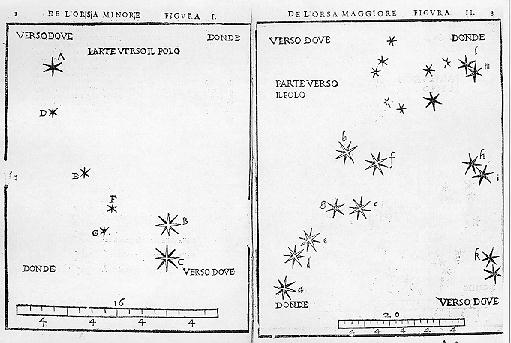
The treatises Sfera del mondo e De le stelle fisse (The sphere of the world and The fixed stars) (1540), in which he adhered to Ptolemaic theories, were some of his major contributions to the field of astronomy. De le stelle fisse contained what is generally regarded as the first printed star atlas, consisting of charts of 47 of the 48 Ptolemaic constellations (Equuleus was missing). Stars down to fourth magnitude were shown, based on Ptolemy’s catalogue in the Almagest.[1] In this atlas Piccolomini labelled the stars with Roman letters, a forerunner of the system of Greek letter identifications that was introduced by Johann Bayer over 60 years later.[2]
Piccolomini also wrote, at the behest of Cosimo de' Medici, a proposal for reforming the calendar (1578). In 1574 Pope Gregory XIII appointed him titular bishop of Patras (Patrae) and Coadjutor Archbishop of Siena.[3]
His comedy Alessandro was adapted by George Chapman into May Day (printed 1611).
The lunar crater Piccolomini is named after him.
See also
Works
- Commentarium de certitudine mathematicarum disciplinarum (in Latin). 1547.
- Sfera del mondo (in Italian). Venezia: Bartolomeo Cesano. 1553.
- Sfera del mondo (in Italian). Venezia: Giovanni Varisco & C. 1561.
- Speculationi de' pianeti (in Italian). Venezia: Giovanni Varisco & C. 1563.
- Libri ad scientiam de natura attinentes (in Latin). Vol. 1. Venezia: eredi Francesco De Franceschi (senese). 1600.
- Libri ad scientiam de natura attinentes (in Latin). Vol. 2. Venezia: eredi Francesco De Franceschi (senese). 1600.
From the 1913 Catholic Encyclopedia
Alessandro Piccolomini — Littérateur, philosopher, astronomer, b. 13 June, 1508; d. 12 March, 1578. He passed his youth in the study of literature and wrote several comedies ("Amor costante", "Alessandro", "Ortensio"), translated into Italian verse Ovid's "Metamorphoses", part of the "Æneid", Aristotle's "Poetics" and "Rhetoric", composed a hundred sonnets (Rome, 1549), and other rhyme. He repudiated in later years "Raffaello" or "Dialogo della creanza donne" as too licentious. In 1540 he became professor of philosophy at Padua, where he wrote "Istituzione di tutta la vita dell' uomo nato nobile e in città libera", "Filosofia naturale" in which he followed the theories of ancient and medieval philosophers, while in his "Trattato della grandezza della terra e dell' acqua" (Venice, 1558), he combatted the Aristotelean and Ptolemaic opinion that water was more extensive than land, thereby provoking, with Antonio Berga, professor at Mondovi, a controversy, in which he was assisted by Giambattista Bennedetti. In astronomy ("Sfera del mondo", "Delle stelle fisse", "Speculazioni de' pianeti") he adhered to the Ptolemaic theory. He also wrote on the reform of the calendar (1578), and a commentary on the mechanics of Aristotle. To counteract "Raffaella" he wrote his "Orazione in lode delle donne" (Rome, 1549). His fame extended beyond Italy. Gregory XIII, in 1574, appointed him titular Bishop of Patræ and coadjutor to Francesco Bandini, Archbishop of Siena, who survived him.
FABIANI, Vita di Alessandro Piccolomini (Siena, 1749 and 1759); TIRABOSCHI, Storia della letteratura italiana, VII, pt. i.
References
- Back to citation Kanas, Nick (2006), Alessandro Piccolomini and the First Printed Star Atlas, Taylor & Francis, doi:10.1080/03085690500362355, S2CID 130463301
- Back to citation Ridpath, Ian. "Alessandro Piccolomini's star atlas".
- Back to citation "Archbishop Alessandro Piccolomini" Catholic-Hierarchy.org. David M. Cheney. Retrieved March 21, 2016
External links
- Cerreta, F. (1960). Alessandro Piccolomini. Siena.
- Alessandro Piccolomini (1508-1579). Un siennois à la croisée des genres et des savoirs. Actes du colloque International (Paris, 23-25 septembre 2010), réunis et présentés par M.F. Piéjus, M. Plaisance, M. Residori, C.I.R.R.I. Centre interuniversitaire de recherche sur la Renaissance italienne, Université Sorbonne Nouvelle Paris 3, 2011
- Piccolomini: Ursa Major and Ursa Minor
- Querelle | Alessandro Piccolomini Querelle.ca is a website devoted to the works of authors contributing to the pro-woman side of the querelle des femmes.