
Chasuble

The chasuble (/ˈtʃæzjʊbəl/) is the outermost liturgical vestment worn by clergy for the celebration of the Eucharist in Western-tradition Christian churches that use full vestments, primarily in Roman Catholic, Anglican, and Lutheran churches.[1] In the Eastern Orthodox Church and in the Eastern Catholic Churches, the equivalent vestment is the phelonion.
"The vestment proper to the priest celebrant at Mass and other sacred actions directly connected with Mass is, unless otherwise indicated, the chasuble, worn over the alb and stole" (General Instruction of the Roman Missal, 337). Like the stole, it is normally of the liturgical colour of the Mass being celebrated.
Origins
The chasuble originated as a sort of conical poncho, called in Latin a paenula or casula or "little house", that was the common outer traveling garment in the late Roman Empire. It was simply a roughly oval piece of cloth, with a round hole in the middle through which to pass the head, that fell below the knees on all sides. It had to be gathered up on the arms to allow the arms to be used freely.
In its liturgical use in the West, this garment was folded up from the sides to leave the hands free. Strings were sometimes used to assist in this task, and the deacon could help the priest in folding up the sides of the vestment. Beginning in the 13th century, there was a tendency to shorten the sides a little. In the course of the 15th and 16th centuries, the chasuble took something like its modern form, in which the sides of the vestment no longer reach to the ankle but only, at most, to the wrist, making folding unnecessary.[2]
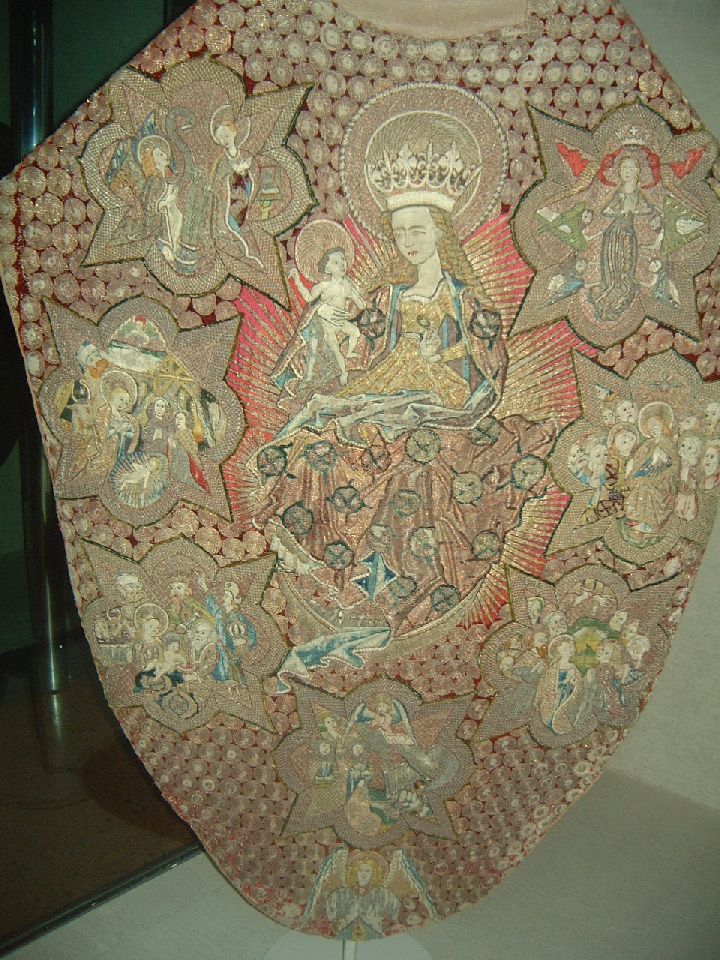
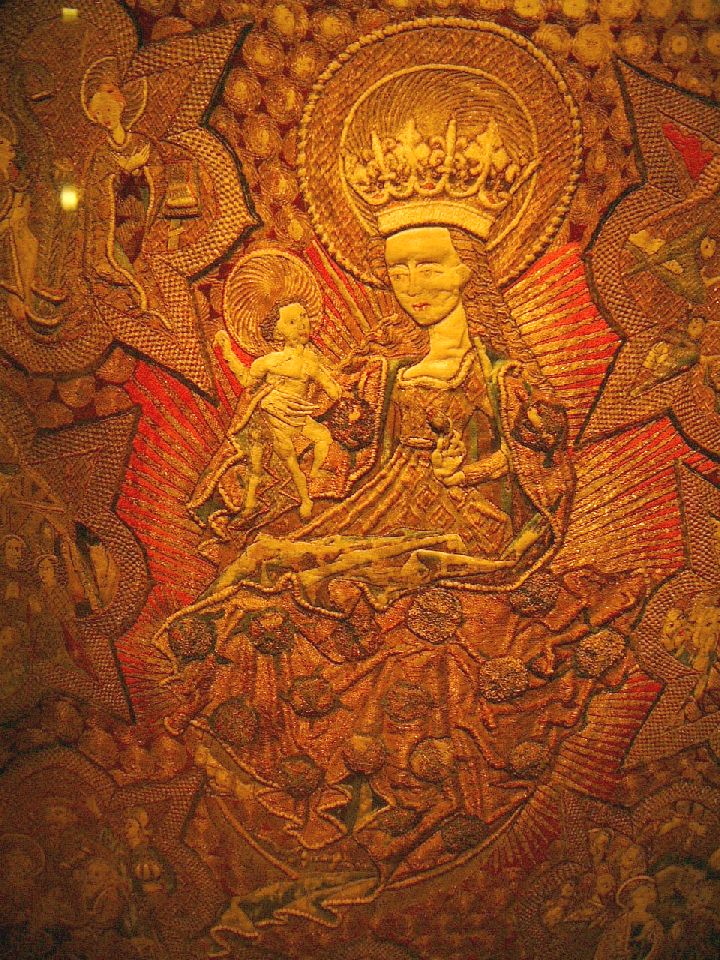
At the end of the sixteenth century the chasuble, though still quite ample and covering part of the arms,[3] had become less similar to its traditional shape than to that which prevailed in the nineteenth and early twentieth centuries, when the chasuble was reduced to a broad scapular, leaving the whole of the arms quite free, and was shortened also in front and back. Additionally, to make it easier for the priest to join his hands when wearing a chasuble of stiff (lined and heavily embroidered) material, in these later centuries the front was often cut away further, giving it the distinctive shape often called fiddleback. Complex decoration schemes were often used on chasubles of scapular form, especially the back, incorporating the image of the Christian cross or of a saint; and rich materials such as silk, cloth of gold or brocade were employed, especially in chasubles reserved for major celebrations.
Current usage
In the 20th century, there began to be a return to an earlier, more ample, form of the chasuble, sometimes called "Gothic", as distinguished from the "Roman" scapular form, which is often associated with Traditional Catholicism, especially in circles which celebrate the Tridentine Mass.[4] However, some traditionalist priests prefer ampler chasubles of less stiff material.[5]
This aroused some opposition, as a result of which the Sacred Congregation of Rites issued on 9 December 1925 a decree against it, De forma paramentorum[6] which it explicitly revoked with the declaration Circa dubium de forma paramentorum of 20 August 1957,[7] leaving the matter to the prudent judgement of local Ordinaries. There exists a photograph of Pope Pius XI wearing the more ample chasuble while celebrating Mass in Saint Peter's Basilica as early as 19 March 1930.[8]
After the Second Vatican Council, the more ample form became the most usually seen form of the chasuble, and the directions of the GIRM quoted above indicate that "it is fitting" that the beauty should come "not from abundance of overly lavish ornamentation, but rather from the material that is used and from the design. Ornamentation on vestments should, moreover, consist of figures, that is, of images or symbols, that evoke sacred use, avoiding thereby anything unbecoming" (n. 344). Hence the prevalence today of chasubles that reach almost to the ankles, and to the wrists, and decorated with relatively simple symbols or bands and orphreys. By comparison, "fiddleback" vestments were often extremely heavily embroidered or painted with detailed decorations or whole scenes depicted.
Pope Benedict XVI sometimes used chasubles of the transitional style common at the end of the 16th century.[9]
In the Slavic tradition, though not in the Greek, the phelonion, the Byzantine Rite vestment that corresponds to the chasuble, is cut away from the front and not from the sides, making it look somewhat like the western cope.
In Catholicism
Called in Latin casula, planeta or pænula, and in early Gallic sources amphibalus. The chasuble is the principal and most conspicuous Mass vestment, covering all the rest. It is described in prayer as the "yoke of Christ" and said to represent charity. Nearly all ecclesiologists are now agreed that liturgical costume was simply an adaptation of the secular attire commonly worn throughout the Roman Empire in the early Christian centuries. The priest in discharging his sacred functions at the altar was dressed as in civil life, but the custom probably grew up of reserving for this purpose garments that were newer and cleaner than those used in his daily ministry, and out of this gradually developed the conception of a special liturgical attire.
In Protestantism
Many, but not all, Lutheran and Anglican churches make use of the chasuble.
The chasuble has always been used by the Lutheran denominations of Scandinavia, although in earlier times its use was not directly connected to the communion. German Lutherans used it for the first two hundred years after the Reformation but later replaced it with the Geneva Gown. A variety of practices emerged in North America but by the mid-20th century, the alb and stole became widely customary. More recently, the chasuble has been readopted for Communion services in both Germany and North America.[10]
In Sweden chasubles, along with the Alb and Cincture, have been used continuously from the middle ages, through the reformation until today.[11]
It is the stole, not the chasuble, that is the priestly vestment.
From the time of the second Prayer Book of Edward VI, the chasuble was discontinued within Anglicanism until revived during the second and third generation of the Oxford Movement in the second half of the 19th century. Technically, it remained illegal in the Church of England until canon law was changed in 1964 (1969 in York) but clergy were rarely prosecuted during the 20th century for nonconformity regarding vesture. While it has widespread usage amongst Anglicans today, it is sometimes still rejected, especially by low-church Anglicans.
It is not customary and rarely seen in Protestantism outside of the liturgical churches.
In popular culture
In Oscar Wilde's 1895 play The Importance of Being Earnest, Dr. Chasuble is a clergyman who, in the 2002 film adaptation, is seen wearing his namesake vestment.
In P.G. Wodehouse's comic short story Mulliner's Buck-U-Uppo, Anglican cleric Stanley Brandon is in "a very bad temper." "He has just had a letter from the bishop, rebuking him for wearing too many orphreys on his chasuble, and it has upset him terribly."
See also
- Ritualism in the Church of England
From the 1913 Catholic Encyclopedia
Called in Latin casula planeta or pænula, and in early Gallic sources amphibalus, the principal and most conspicuous Mass vestment, covering all the rest. Nearly all ecclesiologists are now agreed that liturgical costume was simply an adaptation of the secular attire commonly worn throughout the Roman Empire in the early Christian centuries. The priest in discharging his sacred functions at the altar was dressed as in civil life, but the custom probably grew up of reserving for this purpose garments that were newer and cleaner than those used in his daily avocations, and out of this gradually developed the conception of a special liturgical attire. In any case the Chasuble in particular seems to have been identical with the ordinary outer garment of the lower orders. It consisted of a square or circular piece of cloth in the centre of which a hole was made; through this the head was passed. With the arms hanging down, this rude garment covered the whole figure. It was like a little house (casula). This derivation is curiously illustrated in the prophetic utterance of Druidical origin preserved in Muirchu's "Life of St. Patrick", almost the oldest allusion to the chasuble and crosier which we possess. Before St. Patrick's coming to Ireland the Druids were supposed to have circulated this oracle:
Adze-head [this is an allusion to the peculiar Irish form of tonsure] will come with a crook-head staff; in his house head-holed [in suâ domu capiti perforatâ, i.e. chasuble] he will chant impiety from his table [i.e. the altar]; from the front [i.e. the eastern] part of his house all his household [attendant clerics] will respond, 'So be it! So be it!'
The fact that at an early date the word casal established itself in the Celtic language, and that St. Patrick's casal in particular became famous, makes the allusion of the "house head-holed" almost certain. We can hardly help being reminded of St. Isidore's definition of casula as "a garment furnished with a hood, which is a diminutive of casa, a cottage, as, like a small cottage or hut, it covers the entire person". In the earliest chronicles some modification seems to have already taken place in the primitive conception of a hole cut in round piece of cloth. The early medieval chasubles were made of a semicircular piece of stuff, the straight edge folded in the middle, and the two borders sewn together, leaving an aperture for the head. From this it will be seen that the chasuble is only a cope of which the front edges have been sewn together. The inconvenience of the primitive chasuble will be readily appreciated. It was impossible to use arms or hands without lifting the whole of the front part of the vestment. To remedy this, more than one expedient was resorted to. The sides were gradually cut away while the length before and behind remained unaltered. Thus, after being first curtailed at the sides until it reached but little below the elbows, it was eventually, in the sixteenth century, pared away still farther, until it now hardly extends below the shoulders and leaves the arms entirely free. While this shortening was still in progress, it became the duty of the deacon and subdeacon, assisting the celebrant, to roll back the chasuble and relieve as far as possible the weight on his arms. Directions to this effect are still given in the "Cæremoniale Episcoporum", where it speaks of the vesting of a bishop (Cæremon. Episc., lib. II, cap. viii, n. 19). Another device adopted in some medieval chasubles, to remedy the inconvenience caused by the drag of the vestment upon the arms, was to insert a cord passing through rings by which the sides of the chasuble could be drawn up to the shoulders and secured in that position. This, however, was rare. The chasuble, though now regarded as the priestly vestment par excellence, was in the early centuries worn by all ranks of the clergy. "Folded chasubles" (planetæ plicatæ), instead of dalmatics, are still prescribed for the deacon and subdeacon at high Mass during penitential seasons. The precise origin of this pinning up of the chasuble is still obscure, but, like the deacon's wearing of the broad stole (stolone)--which represents the chasuble rolled up and hung over his shoulder like a soldier's great-coat--during the active part of his functions in the Mass, it probably had something to do with the inconvenience caused by the medieval chasuble in impeding the free use of the arms. Of the chasuble as now in common usage in the Western Church two principal types appear, which may for convenience be called the Roman and the French. The Roman is about 46 inches deep at the back and 30 inches wide. It is ornamented with orphreys forming a pillar behind and a tall cross in front, while the aperture for the neck is long and tapers downwards. The French type, also common in Germany and in a more debased form in Spain, is less ample and often artificially stiffened. It has a cross on the back and a pillar in front. In medieval chasubles these orphrey crosses often assume a Y form, and the crosses themselves seem really to have originated less from any symbolical purpose than from sartorial reasons connected with the cut and adjustment.
Like the other sacred vestments the chasuble, before use, requires to be blessed by a priest who has faculties for that purpose. When assumed in vesting for Mass, the act is accompanied with a prayer which speaks of the chasuble as the "yoke of Christ". But another symbolism is indicated by the form attached to the bestowal of the chasuble in the ordination services: "Receive", says the bishop, "the priestly vestment, by which is signified charity."
BRAUN, Die liturgische Gewandung (Freiburg, 1907), pp. 149-239; ROHAULT DE FLEURY, La Messe (Paris, 1886), VII; BOCK, Geschichte der liturgischen Gewänder (Bonn, 1856-71), II-III; THALHOFER, Liturgik (Freiburg, 1883), I; DE VERT, Explication des cérémonies de l'église (Paris, 1706-8); ROCK, Church of Our Fathers (London, 1903), II; BARBIER DE MONTAULT, Les costumes et les usages ecclésiastiques (Paris, 1901), II; VAN DER STAPPEN, Sacra Liturgia (Mechlin, 1902), IV, 124-188; THURSTON, in THE MONTH (Dec., 1898) and in The Tablet (Dec. 28, 1907); HEFELE, Beiträge (Tübingen, 1864), II, 150-223.
References
- Back to citation See Apology of the Augsburg Confession, Article XXIV
- Back to citation Tribe, Shawn (31 July 2006). "The Development (and Future?) of Vestments in the Roman Rite". Thenewliturgicalmovement.blogspot.com. Retrieved 18 May 2013.
- Back to citation Images of Saint Ignatius Loyola and Saint Philip Neri usually show this form of chasuble. See, for instance, Tiepolo's eighteenth-century picture of the latter in the cited article Philip Neri.
- Back to citation Fortescue, O`Connell & Reid 2009, pp. 32–33; James 1934; Roulin 1950.
- Back to citation "The Rich History of the Fiddleback Chasuble". 5 September 2024.
- Back to citation Bouscaren & O'Connor 1953, p. 262.
- Back to citation Acta Apostolicae Sedis, 49, 1957, p. 762
- Back to citation James 1934.
- Back to citation "Benedict XVI's Pentecost Sunday: again a lesson through vestments". Wdtprs.com. 11 May 2008. Retrieved 18 May 2013.
- Back to citation "What are vestments and paraments" (PDF). Worship Formation & Liturgical Resources: Frequently Asked Questions. Evangelical Lutheran Church in America. 2013. Archived from the original (PDF) on 5 February 2023. Retrieved 27 March 2018.
- Back to citation Piepkorn, Arthur Carl (1907-1973) (1958). The Survival of the Historic Vestments in the Lutheran Church after 1555.
Bibliography
- Bouscaren, Lincoln T; O'Connor, James I. (1953). The canon law digest: officially published documents affecting the Code of canon law. Milwaukee: Bruce Pub. Co. OCLC 2814144.
- Fortescue, Adrian; O`Connell, J.B; Reid, Alcuin (29 January 2009). The Ceremonies of the Roman Rite Described. A&C Black. ISBN 978-1-4411-3808-8.
- James, Raymund (1934). The Origin and Development of Roman Liturgical Vestments (2nd ed.). Exeter: Catholic Records Press.
- Roulin, Eugéne (1950). Vestments and Vesture: A Manual of Liturgical Art. Newman Press.
External links
- Chasuble in Catholic Encyclopedia
- The Development (and Future?) of Vestments in the Roman Rite
- A chasuble, ascribed to Albert the Embroider, second half of the 15th century, in the Uppsala Cathedral Treasury.
- The chasuble from the vestments of the Order of the Golden Fleece in the Secular Treasury of the Hofburg Palace in Vienna.
- Phillips, Walter Alison (1911). "Chasuble". Encyclopædia Britannica. Vol. 5 (11th ed.). pp. 959–960.