

Diocese of Trier
| Diocese of Trier or Treves Dioecesis Trevirensis Bistum Trier | |
|---|---|

Trier Cathedral
| |
| Location | |
| Country | Germany |
| Ecclesiastical province | Cologne |
| Statistics | |
| Area | 12,870 km2 (4,970 sq mi) |
| Population Total Catholics |
(as of 2010) 2,468,000 1,504,500 (61%) |
| Information | |
| Denomination | Catholic Church |
| Sui iuris church | Latin Church |
| Rite | Roman Rite |
| Established | 1st Century |
| Cathedral | Cathedral of Trier |
| Patron saint | Mary, Mother of God Saint Matthias |
| Current leadership | |
| Pope | Leo XIV |
| Bishop | Stephan Ackermann Bishop of Trier |
| Metropolitan Archbishop | Rainer Maria Woelki |
| Auxiliary Bishops | Robert Brahm, Jörg Michael Peters |
| Map | |
| Website | |
| bistum-trier.de | |
The Diocese of Trier (Latin: Dioecesis Trevirensis), in English historically also known as Treves (/triːvz/) from French Trèves, is a Latin Catholic ecclesiastical territory or diocese of the Catholic Church in Germany.[1][2] When it was the archbishopric and Electorate of Trier, it was one of the most important states of the Holy Roman Empire, both as an ecclesiastical principality and as a diocese of the church. Unlike the other Rhenish dioceses—including Mainz and Cologne–Trier was the former Roman provincial capital of Augusta Treverorum. Given its status, Trier has continuously been an episcopal see since Roman times and is one of the oldest dioceses in all of Germany. The diocese was elevated to an archdiocese in the time of Charlemagne and was the metropolitan for the dioceses of Metz, Toul, and Verdun. After the victory of Napoleon Bonaparte of France, the archdiocese was lowered to a diocese and is now a suffragan in the ecclesiastical province of the Archdiocese of Cologne. The diocesan cathedral is the Cathedral of Saint Peter. The Cathedral Chapter retains the right to elect the bishop, rather than selection by papal appointment.[3]
History
The bishops of Trier were already virtually independent territorial magnates in Merovingian times. In 772 Charlemagne granted Bishop Wiomad complete immunity from the jurisdiction of the ruling count for all the churches and monasteries, as well as villages and castles that belonged to the Church of St. Peter at Trier. In his will he also elevated the diocese to the Archdiocese of Trier, with suffragans on both sides of the Rhine. This arrangement lasted over a thousand years.
In Early Modern times, the archdiocese of Trier still encompassed territory along the Moselle River between Trier, near the French border, and Koblenz on the Rhine. The Archbishop of Trier, as holder of an imperial office was traditionally an Imperial Elector of the German king. The purely honorary office of Archchancellor of Gaul arose in the 13th century. In this context that was taken to mean the Kingdom of Burgundy-Arles, technically from 1242 and permanently from 1263, and nominally until 1803. Arles along with Germany and Italy was one of the three component kingdoms of the Empire.
The last elector removed to Koblenz in 1786. From 1795, the territories of the Archbishopric on the left bank of the Rhine — which is to say almost all of them — were under French occupation, and were annexed in 1801 and a separate bishopric established (later assuming control of the whole diocese in 1803). In 1803, what was left of the Archbishopric was secularized and annexed by the Princes of Nassau.
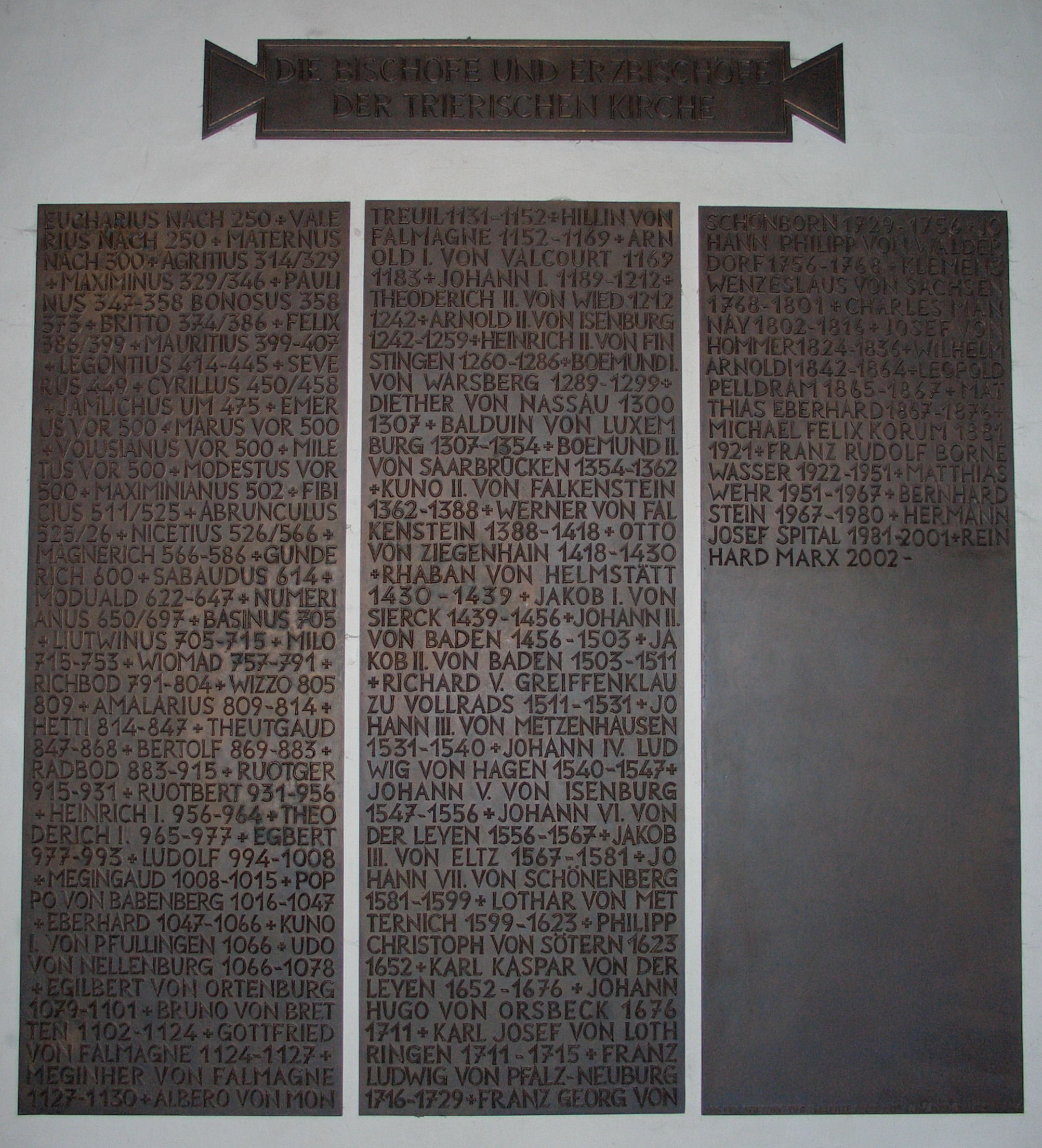
Bishops
Before 1000
- Eucharius c. 250[4]
- Valerius c. 250
- Maternus c. 300
- Auspicius of Trier uncertain
- Agricius (Agrippinus) 327–335
- Maximinus 335–346
- Paulinus 347–358
- Bonosus of Trier 359–365
- Veteranius of Trier 365–384
- Britto of Trier 384–386 (?)
- Felix 384–398
- Mauritius II of Trier 398–407
- Leontius of Trier 407–409
- Auctor II 409–427
- Severus of Trier 428–455
- Cyrillus of Trier 455–457
- Iamblichus of Trier 457–458
- Evemerus 458–461
- Marcus II 461–465
- Volusianus of Trier 465–469
- Miletius 469–476
- Modestus 476–479
- Maximianus of Trier 479–499
- Fibicius 500–526
- Aprunculus (Aprunentius) 526–527
- Nicetius 527–566
- Rusticus II 566–573
- Magnerich 573–596
- Gunderich 596–600
- Sibald 600–626
- Modoald 626–645
- Numerianus 645–665
- Hildulf 665–671, d. 707
- Basinus 671–697 d. 706?
- Leudwinus 697–718
- Milo 718–758
- Wermad 758–791
- Richbod 791–804, first archbishop
- Waso 804–809
- Amalhar 809–814
- Hetto 814–847
- Dietgold 847–868
- Bartholf von Wetterau 869–883
- Radbod 883–915
- Rudgar 915–930
- Rotbert 930–956
- Henry I 956–964
- Dietrich I 965–977
- Egbert 977–993
- Ludolf 994–1008
1000–1200
- contested 1008–1015: Adalbero (elected) versus Meingaud (royal choice)
- Poppo von Babenberg 1016–1047
- Eberhard 1047–1066
- Kuno I von Wetterau (Conrad) 1066–1066
- Udo of Nellenburg 1066–1078
- Egilbert of Rothenburg, 1079–1101
- Bruno 1101–1124
- Gottfrid 1124–1127
- Meginher 1127–1130
- Albero de Montreuil 1131–1152
- Hillin of Falmagne 1152–1169
- Arnold I of Vaucourt 1169–1183
- Folmar of Karden 1183–1189[5]
- Rudolf of Wied 1183–1189 (in opposition)
1200–1500
Archbishop-Electors of Trier
- John I 1189–1212
- Theodoric II 1212–42
- Arnold II von Isenburg 1242–59
- Heinrich I von Finstingen 1260–86
- Bohemond I von Warnesberg 1286–99
- Diether von Nassau 1300–07
- Heinrich II von Virneburg 1300–06 (in opposition)
- Baldwin von Luxemburg 1307–54
- Bohemond II von Saarbrücken 1354–61
- Kuno II von Falkenstein 1362–88
- Werner von Falkenstein 1388–1418
- Otto von Ziegenhain 1418–30
- Rhaban von Helmstadt 1430–38
- Jakob von Sierck † (19 May 1439 Elected – 28 May 1456 Died)
- Johann Markgraf von Baden † (21 Jun 1456 Elected – 9 Feb 1502 Died)
1500–1800
- Jakob Markgraf von Baden † (9 Feb 1503 Succeeded – 27 Apr 1511 Died)
- Richard von Greiffenclau zu Vollrads † (15 May 1511 Elected – 13 Mar 1531 Died)
- Johann von Metzenhausen † (27 Mar 1531 Elected – 22 Jul 1540 Died)
- Johann Ludwig von Hagen † (9 Aug 1540 Elected – 23 Mar 1547 Died)
- Johann von Isenburg † (20 Apr 1547 Elected – 18 Feb 1556 Died)
- Johann von der Leyen † (25 Apr 1556 Elected – 10 Feb 1567 Died)
- Jakob von Eltz † (7 Apr 1567 Elected – 4 Jun 1581 Died)
- Johann von Schönenberg † (31 Jul 1581 Elected – 1 May 1599 Died)
- Lothar von Metternich † (7 Aug 1599 Elected – 17 Sep 1623 Died)
- Philipp Christoph Reichsritter von Sötern † (25 Sep 1623 Elected– 7 Feb 1652 Died)
- Karl Kaspar Reichsfreiherr von Leyen-Hohengeroldseck † (7 Feb 1652 Succeeded – 1 Jun 1676 Died)
- Johann Hugo von Orsbeck † (1 Jun 1676 Succeeded – 6 Jan 1711 Died)
- Karl Joseph Ignaz Herzog von Lothringen † (24 Sep 1710 Elected – 4 Dec 1715 Died)
- Franz Ludwig Pfalzgraf am Rhein zu Neuburg † (20 Feb 1716 Elected – 3 Mar 1729 Resigned)
- Franz Georg Reichsfgraf von Schönborn † (2 May 1729 Elected – 18 Jan 1756 Died)
- Johann Philipp Reichsgraf von Waldendorff † (18 Jan 1756 Succeeded – 12 Jan 1768 Died)
- Klemens Wenzeslaus Herzog von Sachsen † (10 Feb 1768 Elected – 29 Nov 1801 Resigned)[6]
After 1800
Bishops of Trier
- Charles Mannay † (5 Jul 1802 Elected – 9 Oct 1816 Resigned)
- Josef von Hommer † (3 May 1824 Elected – 11 Nov 1836 Died)
- Wilhelm Arnoldi † (21 Jun 1842 Elected – 7 Jan 1864 Died)
- Leopold Pelldram † (29 Dec 1864 Elected – 3 May 1867 Died)
- Matthias Eberhard † (16 Jul 1867 Elected – 30 May 1876 Died)
- Michael Felix Korum † (12 Aug 1881 Elected – 4 Dec 1921 Died)
- Franz Rudolf Bornewasser † (27 Feb 1922 Elected – 20 Dec 1951 Died)
- Matthias Wehr † (20 Dec 1951 Succeeded – 19 Nov 1966 Retired)
- Bernhard Stein † (13 Apr 1967 Elected – 5 Sep 1980 Retired)
- Hermann Josef Spital † (24 Feb 1981 Elected – 15 Jan 2001 Retired)
- Reinhard Marx (20 Dec 2001 Elected – 30 Nov 2007 Translated to become Archbishop of Munich and Freising)
- Stephan Ackermann (8 Apr 2009 Elected – )
Auxiliary bishops
- Nicolas Arlon, O. Carm. (1344–)
- Joannes Franqueloy de Vico, O.P. (1400–1452)
- Gerhard, O.F.M. (1429–1456)
- Hubert Yffz (de Rommersdorf), O. Praem. (1450–1483)
- Johann von Eindhoven, C.R.S.A. (1483–1508)[7]
- Johannes von Helmont, O.S.B. (1508–1517)[8]
- Johannes Enen (1517–1519)[9]
- Nikolaus Schienen (1519–1556)[10]
- Gregor Virneburg (1557–1578)
- Peter Binsfeld (1580–1598)
- Gregor Helfenstein (1599–1632)[11]
- Otto von Senheim, (Johann Theodor von Senheim) O.P. (1633–1662)
- Johannes Holler (1663–1671)[12]
- Johann Heinrich von Anethan (1676–1680)
- Maximilian Burmann (1682–1685)
- Johannes Petrus Verhorst (1687–1708)
- Johann Matthias von Eyss (1710–1729)
- Lothar Friedrich von Nalbach (1730–1748)
- Johann Nikolaus (Febronius) von Hontheim (1748–1790)
- Jean-Marie Cuchot d’Herbain (1778–1794)
- Johann Michael Josef von Pidoll de Quitenbach (1794–1802)
- Johann Heinrich Milz (1825–1833)
- Wilhelm Arnold Günther, O. Praem. (1834–1843)
- Johann Georg Müller (1844–1847)
- Godehard Braun (1849–1861)
- Matthias Eberhard (1862–1867 Appointed, Bishop of Trier)
- Johann Jakob Kraft (1868–1884)
- Heinrich Feiten (1887–1892)
- Karl Ernst Schrod (1894–1914)
- Anton Mönch (1915–1935)
- Albert Maria Fuchs (1935–1944)
- Heinrich Metzroth (1941–1951)
- Bernhard Stein (1944–1967 Appointed, Bishop of Trier)
- Carl Schmidt (1962–1981)
- Karl Heinz Jacoby (1968–1993)
- Alfred Kleinermeilert (1968–2003)
- Leo Schwarz (1982–2006)
- Gehard Jakob (1993–1998)
- Felix Genn (1999–2003, Translated to become Bishop of Essen and later Bishop of Münster)
- Robert Brahm (2003– )
- Jörg Michael Peters (2003– )
- Stephan Ackermann (2006–2009 Appointed, Bishop of Trier)
- Helmut Dieser (2011–2016, Translated, Bishop of Aachen)
- Franz Josef Gebert (2017–2024)
See also
- History of Trier
Canonical status and jurisdiction
Roman Catholic Diocese of Trier is a diocese of the catholic church of the Catholic Church.[13]
External links
From the 1913 Catholic Encyclopedia
Diocese of Trier — (Trevirensis). Diocese; suffragan of Cologne; includes in the Prussian province of the Rhine the governmental department of Trier, with the exception of two districts administered by mayors, and the governmental department of Coblenz with the exception of ten such districts that belong to the Archdiocese of Cologne; it also includes the Principality of Birkenfeld belonging to the Grand Duchy of Oldenburg (see map to article GERMANY). The diocese is divided into 46 deaneries, each administered by a dean and a definitor. In 1911 it comprised 750 parishes, 28 parishes administered by vicars, 200 chaplaincies and similar offices, 70 administrative and school offices. In 1912 there were 711 parish priests, 28 parish vicars, 210 chaplains and curates, 122 ecclesiastics in other positions (administration and schools), 65 priests either retired or on leave of absence, 105 clergy belonging to the orders, 1,249,700 Catholics, and 450,000 persons of other faiths. In most of the country districts the population is nearly entirely Catholic; in the mining and manufacturing districts on the Saar, as well as on the Hunsrück and in the valley of the Nahe River, the Catholic faith is not so predominant. The cathedral chapter has the right to elect the bishop; besides the bishop there is also an auxiliary bishop. The chapter consists of a provost, a dean (the auxiliary bishop), 8 cathedral canons, 4 honorary canons; 6 curates are also attached to the cathedral. The educational institutions of the diocese for the clergy are the episcopal seminar for priests at Trier, which has a regent, 7 clerical professors, and 220 students, and the gymnasial seminaries for boys at Trier and Pr m.
Since the close of the Kulturkampf the religious orders have prospered greatly, and in 1911 there were in the diocese: a Benedictine Abbey at Maria-Laach containing 26 fathers, 80 brothers; a Franciscan monastery on the Apollinarisberg at Reimagen, 9 fathers, 8 brothers; 2 houses of the Capuchins, 18 fathers, 12 brothers; 1 house of the Oblates, 5 fathers, 21 brothers; 2 houses of the Pallotines, 9 fathers, 24 brothers; 1 house of the Redemptorists, 9 fathers, 8 brothers; 1 house of the White Fathers, 5 fathers, 5 brothers; 1 house of the Fathers of the Divine Word, 21 fathers, 50 brothers; 126 Brothers of Charity in 4 houses, and 144 Brothers of St. Francis in 7 houses. The female orders and congregations in the diocese in 1911 were: Benedictine Nuns of the Perpetual Adoration, 1 house with 37 sisters; Sisters of St. Charles Borromeo, 71 houses with 500 sisters; Servants of the Sacred Heart of Jesus, 4 houses, 41 sisters; Serving-Maids of Christ, 30 houses, 193 sisters; Dominican Nuns, 2 houses, 69 sisters; Sisters of St. Francis from the mother-houses at Aachen, Heithuizen, Olpe, and Waldbreitbach, 94 houses, 476 sisters; Capuchin Nuns, 1 house, 10 sisters; Sisters of St. Clement, 1 house, 6 sisters; Nuns of the Visitation, 1 house, 50 sisters; Sisters of the Holy Spirit, 47 houses, 300 sisters; Sisters of the Love of the Good Shepherd, 2 houses, 125 sisters; Sisters of the Poor Child Jesus, 1 house, 9 sisters; Sisters of St. Joseph, 1 house, 20 sisters; Ursuline Nuns, 5 houses, 220 Sisters; Sisters of St. Vincent de Paul, 7 houses; 30 sisters. The most important church of the diocese is the cathedral, the oldest church of a Christian bishop on German soil. The oldest section of the building goes back to the Roman era and was a church as early as the fourth century. In the course of time other parts were added which belong to all forms of architecture, although the Romanesque style preponderates. The cathedral contains the remains of twenty-five archbishops and electors as well as those of the last four bishops of Trier. The most precious of its numerous treasures is the Holy Coat of Christ, which, according to legend, was given to the Church of Trier by St. Helena. Two exhibitions of this venerable relic are worthy of special note: that of 1844, connected with the rise of the sect of German Catholics, and the one held in 1891, which attracted over two million pilgrims. Other noted churches in Trier are: the Church of Our Lady, one of the most beautiful ecclesiastical monuments of Gothic architecture, built 1227-43; the Church of St. Paulinus or of the Martyrs, the burial place of Bishop Paulinus, erected in 1734 in Rococo style to replace the old church destroyed by the French in l674; the thirteenth-century Romanesque church of the former Benedictine Abbey of St. Matthias, containing the grave of St. Matthias, the only grave of an Apostle in Germany; it is much visited by pilgrims. Other noted churches of the diocese are: the churches of St. Castor and Our Lady at Coblenz, the abbey church of Maria-Laach, the old monastery churches of Pr m, M nstermaifeld, and Merzig; the Church of St. Maria at Oberwesel, the Gothic churches of Andernach, Boppard, Remagen, Sinzig, and of other places on the Rhine and the Moselle.
History
The beginnings of the see of Trier are obscure. From the time of Diocletian reorganization of the divisions of the empire, Trier was the capital of Belgica Prima, the chief city of Gaul, and frequently the residence of the emperors. There were Christians among its population as early as the second century, and there was probably as early as the third century a bishop at Trier, which is the oldest episcopal see in Germany. The first clearly authenticated bishop is Agricius who took part in the Council of Arles in 314. His immediate successors were St. Maximinus who sheltered the excommunicated St. Athanasius at Trier, and St. Paulinus, who was exiled to Phrygia on account of his opposition to Arianism. Little is known of the later bishops up to the reign of Charlemagne; during this intervening period the most important ones were St. Nicetius (527-66) and Magnericus (d. 596), the confidant of the Merovingian king, Childebert II. The bishops during the reign of Charlemagne were: Wiomad (757-91), who accompanied the emperor on his campaign against the Avars; Richbod (792-804), one of Alcuin's pupils; and Amalarius Fortunatus (809-14), sent by Charlemagne as ambassador to Constantinople, and the author of liturgical writings. Charlemagne's will proves that Trier at this era was an archdiocese; Metz, Toul, and Verdun are mentioned as its suffragans. In 772 Charlemagne granted Wiomad complete immunity from the jurisdiction of the ruling count for all the churches, monasteries, villages, and castles belonging to the Church of St. Peter at Trier. In 816 Louis the Pious confirmed to Archbishop Hetti (814-47) the privileges of protection and immunity granted by his father. At the partition of the Frankish empire at Verdun in 843, Trier fell to Lothair's empire; at the partition of Lothair's empire at Mersen in 870, it fell to the East-Frankish kingdom which later became the German Empire. However, after the death of Louis the Child, the lords of Lorraine separated from the East-Frankish Kingdom and became vassals of the West-Frankish ruler King Charles the Simple, until Henry I conquered the country for Germany again. Archbishop Ratbod (883-915) received in 898 complete immunity from all state taxes for the entire episcopal territory from the King of Lorraine and Burgundy, Swentibold, son of Emperor Arnulf. He obtained from Louis the Child the district and city of Trier, the right to have a mint and to impose customs-duties; from Charles the Simple he gained the right of a free election of the Bishop of Trier. In this way the secular possessions of the bishops of Trier, which had sprung from the valuable donations of the Merovingian and Carlovingian rulers, were raised to a secular principality. Archbishop Ratbert (931-56), brother-in-law of King Henry I, was confirmed by Otto I in all the temporal rights gained by his predecessors.
Archbishop Poppo (1016-47), son of Margrave Leopold of Austria, did much to enlarge the territory owned by the church of Trier. During the strife over Investiture, Engelbert of Ortenburg (1078-1101) and Bruno of Laufen (1102-24) belonged to the imperial party. Albero of Montreuil (1131-52) had, as Archdeacon of Metz, opposed lay Investiture; during his administration the cathedral school of Trier reached its highest fame. From about 1100 the Archbishop of Trier was the Arch-Chancellor of Gaul, for the German emperor, and thus became the possessor of an imperial office and an Elector of the German king and emperor. As the archbishops of Trier were among the leading spiritual princes of the empire, they became involved in all the struggles between pope and emperor. While Hillin (1152-69) was a partisan of Frederick Barbarossa, Arnold I (1169-83) made successful efforts to bring about a reconciliation between the emperor and pope (1177). John I (1190-1212) was excommunicated by Innocent III on account of his adherence to King Philip of Swabia; Bishop John increased the possessions of the archdiocese by gaining several countships and castles. Theodoric II of Wied (1212-42) belonged to the party of Frederick II, while Arnold II of Isenburg (1242-59) opposed the emperor. Henry II of Vinstingen (1260-86) was the first Archbishop of Trier who took part in the election of a German emperor as one of the seven Electors; the electoral dignity, together with the right to the first vote, was confirmed by the Golden Bull in 1356. As in other German dioceses, so also in Trier, the rising cities, especially Trier and Coblenz, sought to rid themselves of the suzerainty of the bishop. Such attempts were crowned with considerable success during the rule of Archbishop Diether of Nassau (1300-07), brother of King Adolph of Nassau. On the other hand, Baldwin of Luxembourg (1308-54), the most noted of the medieval archbishops of Trier, was able to restore and raise the importance of the See of Trier by his wide-reaching activity both in secular and spiritual affairs. He brought the cities of Coblenz and Trier under his suzerainty again, and was the actual organizer of his possessions as an electoral state. Werner of Falkenstein (1388-1418), one of Baldwin's successors, acquired Limburg on the Lahn; during the great Western Schism he held loyally to Gregory XII. After the death of Otto of Ziegenhain (1418-30), who laboured zealously for the reform of the Church, there was a double election; upon this Pope Martin V appointed a third person archbishop. During the struggle of the candidates to secure the diocese it suffered severely. James of Sierck (1439-56) sought to restore order in the confused finances of the diocese. He was deposed by Eugenius IV as an adherent of the Council of Basle and of the Antipope Felix V, who was elected there. However, the deposition had no effect as the German Electors opposed it. John II, Margrave of Baden (1456-1503), promoted the reform of the Church. He left the diocese heavily in debt, and these debts were increased by his great-nephew and successor, James II of Baden (1503-11).
The Reformation limited the spiritual jurisdiction of the Archdiocese of Trier. Although the energetic Richard von Greiffenklau (1511-31) vigorously opposed the Reformation, still he could not prevent the new doctrine from gaining a foothold in the district of the Hunsr ck, and in that on the right bank of the Rhine. He defeated the attacks of Franz von Sickingen upon the city of Trier, as well as the efforts of that city to become independent of the bishop. In 1512 he exhibited the Holy Coat for the first time and spent the donations of the pilgrims on the cathedral. John II von Metzenhausen (1531-40) attempted reforms which were frustrated by his death. John II von Hagen (1541-47) sent a representative to the Council of Trent and began earnest measures of reform. John V von Isenburg (1547-56) attended the council himself, but was recalled home by the incursion of Margrave Albrecht of Brandenburg-Ansbach into the archdiocese, which the margrave devastated horribly. John VI von der Leyen (1556-67) was able to regain Trier, but could not prevent the French from taking possession of his three suffragan dioceses, Metz, Toul, and Verdun. He checked the further spread of the new doctrines by calling the Jesuits into his diocese (1561). James III von Eltz (1567-81) and John VII von Schönenberg (1581-99) carried out in their possessions the reformatory decrees of the Council of Trent. The former secured the administration of the Abbey of Prüm, whereby the secular possessions of the archdiocese reached their final extent; the latter established two seminaries at Coblenz and Trier. Lothair von Metternich (1599-1623) joined the Catholic League in order to secure the stability of the Catholic Church in Germany. In this way his see became involved in the Thirty Years War. His successor, Philip Christopher von S tern (1623-52), withdrew from the League, formed an alliance with France, and permitted the French to garrison the fortress of Ehrenbreitstein. When he made advances to the Swedes he was captured by the Spanish troops in 1635 under suspicion of heresy, and was kept a prisoner at Vienna until 1645. In the struggle between the imperial troops and the French the archdiocese was often devastated. Charles Caspar von der Leyen (1652-76) had scarcely repaired the damage done by the Thirty Years War by an excellent administration, when the marauding wars of Louis XIV of France brought fresh misery upon the country. John Hugo von Orsbeck (1676-1711) refused to recognize the seizure of some of his territories and their incorporation into France by Louis XIV through what was called the "reunions", neither would take the oath of loyalty to Louis. Consequently, during the years 1684-97 large parts of the see were garrisoned by French troops.
During the long period of peace in the eighteenth century the archdiocese had excellent rulers. Francis Louis von Pfalz-Neuburg (1716-29) gave particular attention to the organization of the administration of justice, and raised the decaying university by establishing new professorships. Francis George von Sch nborn (1729-56) encouraged learned studies and founded a university library and building. The short administration of John Philip von Walderdorf (1756-68) was followed by the reign of the last Elector of Trier, Clement Wenceslaus, Duke of Saxony (1768-1812), who was also Bishop of Augsburg. He gained a reputation by improving the schools and reforming the monasteries, but, on the other hand, influenced by the ideas of the "Enlightenment", he supported Febronianism, shared in the labours of the Congress of Ems (q.v.), and also was involved in the dispute about the nunciatures (see NUNCIO). After the outbreak of the French Revolution the territories of Trier, especially Coblenz, became the gathering place of the French émigrés. In 1794 Trier and Coblenz were besieged by the French. In 1797, by the Peace of Campo-Formio, the part of the archdiocese on the left bank of the Rhine was ceded to France; in 1797 the university was suppressed. In 1801 the Peace of Lunéville gave to France, in addition, the fortress of Ehrenbreitstein. When the German Church was secularized in 1803, the section of the archdiocese on the right bank of the Rhine was also secularized and the greater part of it was incorporated into Nassau. Clemens Wenceslaus renounced his rights in return for an annual pension of 100,000 gulden and withdrew to the Diocese of Augsburg. An ecclesiastical administration, which lasted until 1824, was established in Ehrenbreitstein for the part of the former archdiocese on the right bank of the Rhine. The French Diocese of Trier was established in 1801 for the section of the former archdiocese which had been ceded to France. It embraced hardly a third of the old diocese and was made suffragan to Mechlin. Its first and only bishop was Charles Mannay (1802-16). The Congress of Vienna gave the territory included in this diocese once more to Germany, largely to Prussia and the Grand Duchy of Oldenburg. In 1816 Bishop Charles Mannay resigned his office and retired to France, where he died in 1824 as Bishop of Rennes. For six years the see remained vacant, the administration being conducted in the interim by Hubert Anthony Corden as vicar-general, from 1818 as vicar Apostolic. On the reorganization of the Catholic Church in Prussia in 1821, Trier was revived as a simple diocese by the Bull "De salute animarum", made suffragan to Cologne, and received about its present territory. In 1824 it contained 531 parishes with 580,000 Catholics.
The first bishop of the new diocese was Joseph von Hommer (1824-36). The election of his successor, William Arnoldi (1842-64) which took place in 1839 and was renewed in 1842, was not recognized by the Government until Frederick William IV ascended the throne. Arnoldi did a great deal for the reawakening of Catholic consciousness in Germany. The exhibition of the Holy Coat, which he brought about in 1844, led to the forming of the sect called German Catholics. He was succeeded by Leopold Pelldram (1865-67), formerly chaplain general of the Prussian army, who was followed by Matthias Eberhard (1867-76), who enjoys the honours of a Confessor of the Faith. Eberhard was one of the first to suffer by the Kulturkampf which broke out in Prussia. After being repeatedly condemned to pay heavy fines he was sentenced on 6 March, 1876, to ten months imprisonment. Trier was one of the dioceses that suffered the most during the Kulturkampf. The number of its parishes robbed of their parish priests amount to 197, while nearly 294,000 Catholics lacked regular spiritual care. After the death of the bishop on 30 May, 1876, the see was vacant for five years and had to be secretly administered by an Apostolic Delegate. Finally in 1881, through the personal efforts of Leo XIII, an agreement was made with the Prussian Government, and Mich l Felix Korum (cathedral canon and parish priest of the minster at Strasburg) was appointed Bishop of Trier by the pope, consecrated at Rome on 19 August, and enthroned on 25 September. Up to the present day the bishop has sought to repair the damage inflicted upon his diocese by the Kulturkampf, through the confessional, the pulpit, and religious associational life. He has founded religious institutions for education, and promoted the establishment of numerous houses of the orders. The exhibition of the Holy Coat in 1891 which he carried out was the occasion for impressive demonstrations of Catholic faith and life in Germany (cf. Korum, "Wunder und Gnadenerweise, die sich bei der Austellung 1891 zugetragen haben", Trier, 1894).
A complete bibliography is to be found in MARX, Trevirensia. Literaturkunde zur Gesch. der Trierer Lande (Trier, 1909). Most important works are: BROUWER AND MASENIUS, Antiquitatum et annalium Trevirensium libri XXV (Li ge, 1670-71); HONTHEIM, Hist. Trevirensis diplomatica et pragmatica (Augsburg and W rzburg, 1750); IDEM, Prodromus Hist. Trevirensis (1757); Gesta Trevirorum, ed. WYTTENBACH AND M LLER (Trier,1836-39); MARX, Gesch. des Erzstifts Trier (5 vols., Trier, 1858-1864); G RZ, Regesten der Erzbisch fe zu Trier von Hetti bis Johann II, 814-1503 (Trier, 1859-61); IDEM Mittelrheinische Regesten (Coblenz, 1876-86); Codex diplomaticus Rheno-Mosellanus, ed. G NTHER (5 vols. Coblenz, 1822-26); Urkundenbuch zur Gesch. der mittelrheinischen Territorien, ed. ZEYER, ELTESTER, AND G RZ (Coblenz, 1860-74); DE LORENZI, Beitr ge zur Gesch. s mtlicher Pfarreien der Di zese Trier (Trier, 1887); SAUERLAND, Trier Geschichtsquellen (Trier, 1889); IDEM, Urkunden u. Regesten zur Gesch. der Rheinlande aus dem vatikansichen Archiv (4 vols., Bonn, 1902-07); SCHORN, Eiflia illustrata (Bonn, 1888-1892); NEY, Die Reformation in Trier 1559 ihre Entstehung (Leipzig and Halle, 1906-07); VON SCHR TTER, Die M nzen von Trier, II (Bonn, 1908); BASTGEN, Die Gesch. des Trierer Domkapitels im Mittelalter (Paderborn, 1910); EWALD, Die Siegel der Erzbisch fe von Trier (Bonn, 1910). On art and architecture: VON WILMOWSKY, Der Dom zu Trier (Trier, 1874); IDEM, Die Grabst tten der Erzbisch fe von Trier (Trier, 1876); BEISSEL, Gesch. der Trierer Kirchen (1888-89); KR GER AND KENTENICH, Trier zur R merzeit u. im Mittelalter (Leipzig, 1911); VON SCHLEINITZ, Trier (Leipzig, 1909). One of the series, Ber hmte Kunst tten; CRAMER, Das r mische Trier (G tersloh, 1911). Most important periodicals: Trierisches Archiv (Trier, 1898——), and its supplementary numbers (Trier, 1901——); Westdeutsche Zeitschrift f r Gesch. u. Kunst (Trier, 1882——), with supplementary numbers.
References
- Back to citation "Diocese of Trier" Catholic-Hierarchy.org. David M. Cheney. Retrieved February 29, 2016
- Back to citation "Diocese of Trier" GCatholic.org. Gabriel Chow. Retrieved February 29, 2016
- Back to citation "Diocese of Trier".
- Back to citation Bistum Trier - Bistum - Geschichte/Bischöfe Archived 2007-09-28 at the Wayback Machine
- Back to citation Because Folmar was never formally installed in the see, he is often omitted (as is Rudolf of Wied) from official lists of the Bishops of Trier, e.g., the list displayed in Trier Cathedral.
- Back to citation From 1801, after the French conquest of the Imperial territories on the left-bank of the Rhine, Clemens Wenzel of Saxony was archbishop with effect on the right bank only.
- Back to citation "Bishop Johann von Eindhoven, C.R.S.A." Catholic-Hierarchy.org. David M. Cheney. Retrieved August 6, 2016
- Back to citation "Bishop Johannes von Helmont, O.S.B." Catholic-Hierarchy.org. David M. Cheney. Retrieved August 28, 2016
- Back to citation "Bishop Johannes Enen" Catholic-Hierarchy.org. David M. Cheney. Retrieved August 6, 2016
- Back to citation "Bishop Nikolaus Schienen" Catholic-Hierarchy.org. David M. Cheney. Retrieved August 29, 2016
- Back to citation "Bishop Gregor Helfenstein" Catholic-Hierarchy.org. David M. Cheney. Retrieved August 29, 2016
- Back to citation "Bishop Johannes Holler" Catholic-Hierarchy.org. David M. Cheney. Retrieved August 29, 2016
- Back to citation Roman Catholic Diocese of Trier, official website
Bibliography
- (in German) Die Bischöfe von Trier
- (in English) Diocese of Trier in the 1908 Catholic Encyclopaedia