Skufia

A skufia (also skufiya, skoufia or skoufos; Greek: σκούφια or σκούφος) is an item of clerical clothing, a cap, worn by Eastern Orthodox, Eastern Lutheran and Eastern Catholic monastics (in which case it is black) or awarded to clergy as a mark of honor (in which case it is usually red or purple).
Origin
The skufia is said to originate from Jewish headwear in Old Testament times. It is also said to represent the crown of thorns worn by Christ at His crucifixion.[1]
Description
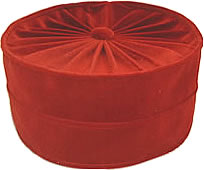
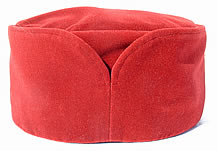
A skufia is a soft-sided brimless cap whose top may be pointed (Russian style),[2][3] flat with embroidered designs (Serbian style),[4] flat and pleated (Greek style),[5] or flat with raised edges (Romanian style).[6] Typically, monastics receive their skufia either when they first become a novice or when they are tonsured.[7] A monk or nun who has been tonsured to the Great Schema will wear a skoufia that has been embroidered with prayers, crosses, and figures of seraphim.[8]
In Russian Orthodox and Orthodox Church in America practice, priests and deacons who have been awarded the purple kamilavka regularly wear a black skufia outside of liturgical worship. However, any clergy from the rank of Reader is permitted to wear the black skufia, if they have received a blessing from their bishop.[9] After five years of being a priest, they are awarded a purple skufia in place of the black one.[10]
High-ranking bishops (such as archbishops and metropolitans) will sometimes wear a black or purple skufia with a small jewelled cross on informal occasions.[11] A nun will sometimes wear a skufia over her monastic veil;[12] while monks often wear the skufia (without a veil) when the klobuk or epanokamelavkion might get in the way of work.
See also
- Apostolnik
- Biretta
- Kalimavkion
- Klobuk
- Koukoulion
- The Philippi Collection
- Taqiyah
- Zucchetto
General bibliography
- Philippi, Dieter (2009). Sammlung Philippi: Kopfbedeckungen in Glaube, Religion und Spiritualität. Leipzig: St. Benno Verlag. ISBN 978-3-7462-2800-6.
References
- Back to citation "Diversity of Skufias - Tips for Clergy". catalog.obitel-minsk.com. Retrieved 2025-06-24.
- Back to citation The Russian-style skufia is traditionally pulled down so that it covers the top of the ears. This is practical, to keep out the cold; but it also has a symbolic practice, reminding the monk not to listen to gossip.
- Back to citation thumb_p2433d.jpg Archived October 13, 2003, at the Wayback Machine Retrieved 9 October 2015 Skufia Russian style
- Back to citation "Image: _2_12.jpg, (900 x 600 px)" catalog.obitel-minsk.com. Retrieved 24 June 2025.
- Back to citation "Image: red.jpg, (204 × 170 px)". nikitatailor.com. Retrieved 9 October 2015.
- Back to citation "Image: red2.jpg, (217 × 151 px)". nikitatailor.com. Retrieved 9 October 2015.
- Back to citation "Ambr6.jpg". newsketemonks.com. Archived from the original on 7 April 2008. Retrieved 29 December 2016.
- Back to citation "1115". sestry.ru. Retrieved 29 December 2016.
- Back to citation "HTC: Priest's Headcoverings During Divine Worship". www.holy-trinity.org. Retrieved 2025-06-24.
- Back to citation "HTC: Liturgical Ranks". www.holy-trinity.org. Retrieved 2025-06-24.
- Back to citation DSC_0006.jpg Archived February 22, 2006, at the Wayback Machine
- Back to citation long.protest.ap.jpp.jpg Archived February 22, 2006, at the Wayback Machine