

Cathedra

A cathedra is the throne of a bishop, found in the cathedral church of their diocese. The word derives from the Greek καθέδρα (kathédra), meaning "seat", especially one used by a bishop or teacher;[1] this term is also the ultimate source of the word "chair".[2]
Cathedrae apostolorum
The term appears in early Christian literature in the phrase cathedrae apostolorum, indicating authority derived directly from the apostles.[3][4]
Ex cathedra
The doctrine of papal infallibility, the Latin phrase ex cathedra (literally, "from the chair") was proclaimed at the First Vatican Council by Pius IX in 1870 as meaning "when, in the exercise of his office as shepherd and teacher of all Christians, in virtue of his supreme apostolic authority, the Bishop of Rome defines a doctrine concerning faith or morals to be held by the whole Church."[5][6]
Cathedra as bishop's see
Tertullian (c. 155 – c. 240?) was the first to use cathedra in the meaning of a bishop's see.[6]
Cathedrals as a bishop's seat
Eventually, the main church of a diocese, used as the primary church by its bishop, received the title "cathedral".[7] The cathedral is literally the church into which a bishop's official cathedra is installed.
The Joint International Commission for Theological Dialogue Between the Catholic Church and the Orthodox Church makes use of the term cathedral to point out the existence of a bishop in each local church, in the heart of ecclesial apostolicity.[8]
Notable examples
Cathedra Petri
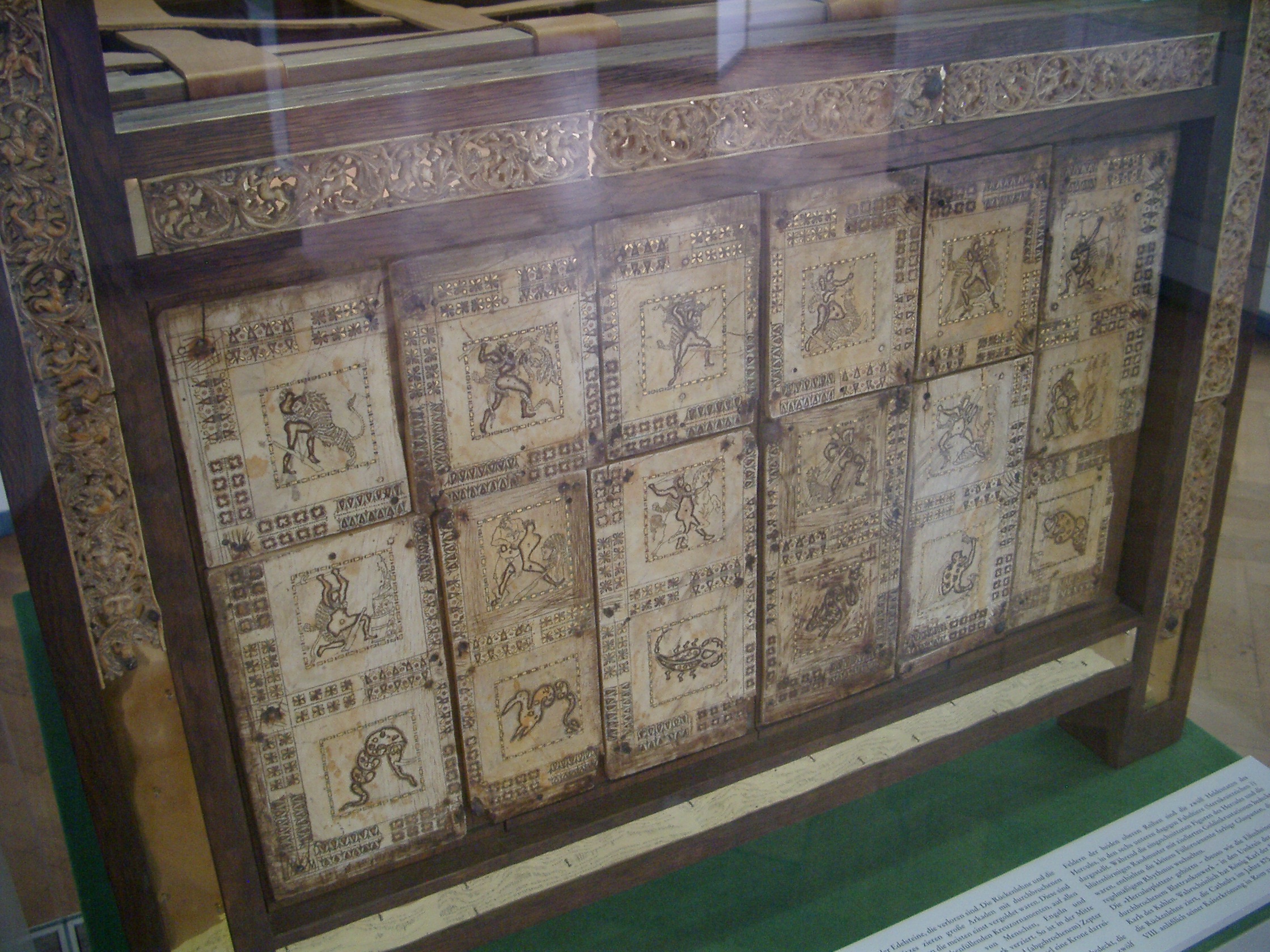
The definitive example of a cathedra is that encased within the Triumph of the cathedra Petri designed by Gian Lorenzo Bernini in 1657, and completed and installed in St Peter's Rome in 1666. As early as the 8th century, an ancient wooden chair overlaid with ivory plaques depicting The Twelve Labours of Heracles and some of the constellations,[9] was venerated as the episcopal chair of St. Peter. It is a Byzantine throne with framed fragments of acacia wood, encased in the oak carcass and reinforced with iron bands. It was long believed to have been used by the Apostle Saint Peter, but the Holy See recognises that the chair was a gift from Holy Roman Emperor Charles the Bald to Pope John VIII in 875.[10] Several rings facilitated its transportation during processions. Pope Alexander VII commissioned Bernini to build a monument to display this relic in a triumphant manner. Bernini's gilded bronze throne, richly ornamented with bas-reliefs, encloses the relic. On January 17, 1666, it was solemnly set above the altar of Saint Peter's Basilica in Vatican City. Greater than life-sized sculptures of four Doctors of the Church form an honour guard: St. Ambrose and St. Athanasius on the left, and St. John Chrysostom and St. Augustine on the right.
Celebrated on February 22 in accordance with the calendar of saints, the Feast of Cathedra Petri (the Feast of the Chair of Peter the Apostle) honours the founding of the church in Rome and gives thanks for the work of Saint Peter.
Chair of Bishop Maximianus
A fifth- or sixth-century bishop's throne decorated with elaborate ivory carving is preserved in the sacristy of the cathedral at Ravenna. It bears a monogram in front, "Maximianus ep.", which gave it its name. The identity of the bishop is given by the 1908 Catholic Encyclopedia as Maximianus of Constantinople (d. 431), considered as more likely than Maximianus of Ravenna (d. 556).[6]
Chair of St. Augustine
The Chair of St. Augustine represents one of the most ancient extant cathedrae in use. Named after the first Archbishop of Canterbury, St. Augustine of Canterbury, it is made of Purbeck Marble or Bethesda marble and dates to sometime between the 6th and 12th centuries. Those who argue for an older date suggest that it may have been used to crown the kings of Kent. Canterbury Cathedral, in which the cathedra is housed, maintains that the chair was once part of the furnishings of the shrine of St. Thomas Becket, since dismantled.[11] Since the Middle Ages, it has always been used in the triple enthronement of an Archbishop of Canterbury. He is seated on the throne in the quire as Diocesan Bishop, in the chapter house as titular abbot, and in St. Augustine's chair as Primate of All England. This is the only occasion in which the cathedra is used. A second cathedra is used for other occasions at which the archbishop is present.
Placement
The early Christian bishop's throne, or cathedra, stood in an elevated position behind the altar, near the wall of the apse.[7] It had been the position of the magistrate in the apse of the Roman basilica, which provided the model type—and sometimes were adapted as the structures—for early Christian basilicas.
Western churches
In the Middle Ages, as altars came to be placed against the wall of the apse, the practice of placing the cathedra to one side (mostly left) became standard.
In the Roman Catholic Church since the Second Vatican Council, the altar is often free-standing. The cathedra in cathedrals built or renovated after Vatican II is sometimes placed behind the altar, as in ancient Roman basilicas.
In Anglican practice, the cathedra tends to be placed to one side in the choir, although in more contemporary practice, it is commonly placed on the gospel side of the chancel (i.e., to the left of the altar, as one looks at it from the front).
Eastern churches
Eastern Orthodox and Byzantine Rite Catholic churches have a throne for the bishop in the apse behind the holy table, with seats for the priests (Greek: synthranon) arranged to either side. This location is referred to as the "high place" and represents the presence of Christ presiding over the services, even when the bishop is not present and therefore an icon of Christ is often placed above the bishop's throne. The bishop ascends to the high place only during the divine liturgy, at the Trisagion. For this reason, the consecration of a bishop takes place at the Trisagion, so that he may ascend to the high place for the first time as a bishop during the liturgy at which he is consecrated.
Another throne is provided for the bishop in the nave of the church:
- In the Greek Orthodox Church practice, this is normally located along the southern wall of the church, on the kliros. In this style, it is one of the monastic choir stalls (kathismata), only more elaborately carved, usually at the top of three steps, and with a canopy above it. During the divine liturgy, the deacon ascends to this throne to read the gospel, facing west.
- In the Russian Orthodox Church practice, the kafedra (Russian: кафедра, káfedra) is a large square platform set in the very center of the nave, with a removable chair or faldstool placed on it. This arrangement is a remnant of the ancient bemah (Greek: amvon), borrowed from the Jewish synagogue, which stood in the center of the church in ancient times. Sometimes during the liturgy, the deacon stands on this platform, facing east, to read the gospel.
An orlets is usually placed at both the high place and the throne in the nave. An orlets is usually kept permanently on the Russian kafedra, even when the chair is removed; the orlets is, however, removed when a deacon stands on the kafedra to read the gospel.
See also
- Chapter (religion)
- Curule seat, Roman chair used as sign of power
- Episcopal see
- Pulpit
- Lists of cathedrals
From the 1913 Catholic Encyclopedia
(1) The chair or throne (thronos) of a bishop in his cathedral church, on which he presides at solemn functions. Originally the bishop's Cathedra stood in the center of the apse, flanked on either side, though on a lower plane, by the benches of the assisting priests. A good idea of the arrangement may be had from the catacomb frescoes representing Christ seated on a throne surrounded by the apostles, whom He is instructing in their future duties, and in the fourth century mosaic in the apse of St. Pudenziana. The earliest type of bishop's throne consisted of a high-backed armchair, rounded at the top, made out of a single block of marble. The stone seats in the Roman catacombs of similar form were probably used by the bishop in the occasional services of the subterranean chapels. Wooden episcopal chairs were in use in Africa. The marble chair supporting the famous statue of St. Hippolytus (third century) is an excellent example of an ancient cathedra; the back has less than half the elevation of the thrones of the fourth and fifth centuries. In several Roman basilicas e.g. St. Petronilla, St. Bablina, and Sts. Nereus and Achilleus, a niche for the bishop's cathedra was constructed in the wall of the apse, but this arrangement was exceptional. An example of a cathedra with a perforated seat, like those used in the Roman baths, is preserved at Monte Cassino. The form and decoration of the most ancient of episcopal cathedrae were borrowed from paganism; one side of the chair of St. Hippolytus, however, is engraved with the saint's computation of the paschal cycle from the year 222 to 334. During the early centuries of Christianity it was customary for the bishop to deliver his sermon or homily while seated in his chair facing the congregation, but in the great basilicas of the Constantinian era, as well as subsequently, this arrangement became impracticable; it would have been extremely difficult in a large church to be heard from this location, particularly in a church where the altar was surmounted by a ciborium. St. John Chrysostom was accustomed to address his great audience from the better-adapted lector's ambon in front of the altar. It appears probable also that in some instances the episcopal cathedra was moveable, and thus could be placed near the chancel while the bishop addressed the congregation. This inference is suggested by the famous chair of Bishop Maximianus at Ravenna, the back of which, as well as the sides, contains sculptured ornamentation; if the chair was to remain stationary against the wall of the apse, the adornment of the back would have been superfluous. In a church ornamented with an iconostasis, a moveable episcopal chair became especially necessary if the bishop wished to preach from his throne, for otherwise he would be almost wholly shut out from view of the congregation. The two most famous ancient cathedrae still preserved are the chair of Maximianus mentioned above, and the chair of St. Peter. The latter, a moveable chair, stood in the time of Ennodius of Pavia (d.521), who alludes to it, in the baptistery of St. Peter's. During the pontificate of Alexander VII (1655-1667) it was encased in the bronze throne in the apse of the new St. Peter's, where it remained invisible till 1867. It was then, on the occasion of the eighteenth centenary of the martyrdoms of Sts. Peter and Paul, by order of Pius IX, removed from its bronze enclosure and exposed to the gaze of the faithful. De Rossi took advantage of the moment, and gave a description of the chair in his "Bullettino" (1867, 33 sqq.). The oak framework, in which four large rings are fastened, is regarded as of much greater antiquity than the other parts of the cathedra; the presence of the rings suggests the inference that originally the chair was one of the "sedes gestatoriae", which came into fashion in the reign of Claudius (41-54). The wear and tear of time, and the zeal of the relic-hunter, made extensive repairs necessary at a later period, perhaps in the reign of Charlemagne. The oak frame was reinforced by the insertion of pieces of acacia, and new panels of the same wood were made for the front and sides. The front panel is adorned with square slabs of ivory, disposed in three rows of six each, representing the labors of Hercules. Some of these slabs are placed upside down and were not, apparently, made for the places they occupy. The ivory ornaments of the back, on the contrary, are well adapted to the form of the chair; they represent the combats of animals, of centaurs and of men. In the center of the horizontal bar of the tympanum is the figure of an emperor, between two angels, variously supposed to represent Charlemagne, Charles the Bald, or an emperor of the seventeenth century.
The ivories of the front panel are attributed to.the fifth century. The beautiful ivory chair of Bishop Maximianus (so called from the monogram in front, "Maximianus ep.") preserved in the sacristy of the cathedral at Ravenna is an excellent specimen of fifth- or sixth-century ivory carving. Until recentl y it was attributed to the pontificate of Bishop Maximianus of Ravenna (d. 556), but Venturi (Storia dell' Arte Ital., I, 466) attributes it rather to Maximianus of Constantinople (d. 431). The back is engraved with twenty four scenes from the life of Christ and the Blessed Virgin, the front represents St. John the Baptist with the four Evangelists, while on the sides the story of Joseph, in ten scenes, is depicted. Occasionally, the cathedra was covered by a baldachino, e.g. at Torcello and Grado. The marble cathedra of St. Mark, in his church at Venice, is of great antiquity (Secchi, La catedra di San Marco, Venice, 1835).
(2) The term cathedra was applied also to the see of a bishop. The earliest use of the word in this sense occurs in Tertullian, who speaks (De praescriptione, XXXVI) of "cathedrae Apostolorum" in allusion to Apostolic succession in episcopal sees. In the councils and ecclesiastical writings of the early Middle Ages such expressions as "cathedrae viduatae", "cathedrae principales", "cathedrae matrices" have a similar signification. For the feast of the "chair" or "cathedra" of St. Peter at Rome and at Antioch, see CHAIR OF PETER.
(3) Canon 41 of the Council of Aachen, held in 789, refers to the cathedral church as distinguished from other churches of a diocese as "principalis cathedrae"; the term for the official seat of the bishop is thus employed for the bishop's church. By a definition "ex cathedra" is meant a formal infallible decision of the pope, obligatory on all the faithful. See also, FALDSTOOL.
Haddan, in dictionary of Christian Antiquities, s. v. (London, 1875); I: Lowrie, Monuments of the Early Church, (New York, 1901); Venturi, Storia dell' Arte Italiana (Milan, 1901); Kraus, Gesch. der christl. Kunst (Freiburg, 1896); Kaufmann, Christl. Archäologie (Paderborn, 1905); de Fleury, La Messe, II, 147 sqq.
References
- Back to citation "cathedra". Oxford English Dictionary (online ed.). Oxford University Press. doi:10.1093/OED/5887432099. (Subscription or participating institution membership required.)
- Back to citation "chair". Oxford English Dictionary (online ed.). Oxford University Press. doi:10.1093/OED/5186691526. (Subscription or participating institution membership required.)
- Back to citation Tertullian, "De Praescriptione Haereticorum: XXXVI", (in Latin) Tertullian.org, Accessed January 30, 2010
- Back to citation Tertullian, "The Prescription Against Heretics: Chapter 36", Tertulllian.org, Accessed January 30, 2010
- Back to citation Henry Edward Manning (1871). De Fide, quaest. xii, apud Rocaberti, tom. xx, p. 388, quoted in The Vatican Council and Its Definitions: Pastoral Letter to the Clergy. p. 105. Retrieved 2020-01-15. “Ferre also writes:"The exposition of certain Paris (doctors) is of no avail, who affirm that Christ only promised that the faith should not fail of the Church founded upon Peter; and not that it should not fail in the successors of Peter taken apart from (seorsum) the Church"”
- Back to citation occurrence 6.0 Back to citation occurrence 6.1 Back to citation occurrence 6.2 Hassett, Maurice (1908). "Cathedra". The Catholic Encyclopedia. Vol. 3. New York: Robert Appleton Co. Retrieved 4 January 2020 – via transcription for New Advent by Tom Crossett.
- Back to citation occurrence 7.0 Back to citation occurrence 7.1 Editors of the EB. "Cathedra (chair)". Encyclopaedia Britannica. Retrieved 4 January 2020.
- Back to citation "The Sacrament of Order in the Sacramental Structure of the Church with Particular Reference to the Importance of Succession for the Santification and Unity of the People of God", Orthodox - Roman Catholic International Dialogue, 1988
- Back to citation "Cathedra Petri, 9th century. Römisches Germanisches Museum Mainz. Archived copy". Archived from the original on 2009-02-05. Retrieved 2009-01-30.
- Back to citation "Interior of the Basilica". Vatican State. Archived from the original on 16 May 2017. Retrieved 20 March 2013.
- Back to citation "Welcome to Canterbury Cathedral". www.canterbury-cathedral.org. Retrieved 17 March 2018.

External links
- "Cathedra Petri", Catholic Encyclopedia
- Orthodox bishop seated at the High Place
- Russian bishop seated on kathedra
- Greek Bishop on throne in the kliros (Church of the Holy Sepulchre)
- Russian Orthodox Patriarch standing at kafedra in center of Christ the Saviour Cathedral, Moscow
- Russian Patriarch sitting at kafedra
- Russian Patriarch sitting at High Place


