Codex Amiatinus

The Codex Amiatinus, also known as the Jarrow Codex, is considered the best-preserved manuscript of the Latin Vulgate version[1] of the Christian Bible. It was produced around 700 in the northeast of England, at the Benedictine Monkwearmouth–Jarrow Abbey in the Kingdom of Northumbria, now South Tyneside. It was one of three giant single-volume Bibles then made at Monkwearmouth–Jarrow, and is the earliest complete one-volume Latin Bible to survive, only the León palimpsest being older. It is the oldest Bible where all the biblical canon present what would be their Vulgate texts. In 716 it was taken to Italy as a gift for Pope Gregory II. It is named after the location in which it was found in modern times, Monte Amiata in Tuscany, at the Abbazia di San Salvatore and is now kept at Florence in the Biblioteca Medicea Laurenziana (Laurentian Library).
Designated by siglum A, it is commonly considered to provide the most reliable surviving representation of Jerome's Vulgate text for the books of the New Testament, and most of the Old Testament. As was standard in all Vulgate Bibles until the ninth century,[2] the Book of Baruch is absent as is the Letter of Jeremiah, the text of the Book of Lamentations following the end of Jeremiah without a break.[3] Ezra–Nehemiah is presented as a single book, the texts of the canonical Book of Ezra and Book of Nehemiah being continuous. Similarly the books of Samuel, Kings and Chronicles are each presented as a single book.[4]
Description
The designated siglum for the manuscript in most critical editions is written am or A (Wordsworth). It is preserved in an immense tome, measuring 191⁄4 inches (49 cm) high, 133⁄8 inches (34 cm) in breadth, and 7 inches (18 cm) thick, and weighs over 75 pounds (34 kg) – so impressive, as biblical scholar Fenton J. A. Hort says, as to fill the beholder with a feeling akin to awe.[5][6]
The Book of Psalms is provided in Jerome's third version, translated from the Hebrew, rather than in the pre-Jerome Roman Psalter then standard in English bibles, or in Jerome's second, Gallican version, that was to supplant his Hebraic Psalms in most Vulgate bibles from the 9th century onwards. By contrast with most of the Old Testament, the Amiatinus psalms text is commonly considered an inferior witness to Jerome's Versio iuxta Hebraicum (Translation according to the Hebrew); the presence of the 'Columba' series of psalm headings, also found in the Cathach of St. Columba, demonstrates that an Irish psalter must have been its source; but the text differs in many places from the best Irish manuscripts. The New Testament is preceded by the Letter of Jerome to Pope Damasus, and the Prolegomena to the four Gospels.
The Codex Amiatinus qualifies as an illuminated manuscript as it has some decoration including two full-page miniatures, but these show little sign of the usual insular style of Northumbrian art and are clearly copied from late antique originals. It contains 1,040 leaves of strong, smooth vellum, fresh-looking today despite their great antiquity, arranged in quires of four sheets, or quaternions. As noted by scholar Christopher de Hamel, "[t]he 1030 leaves of the Codex Amiatinus would have utilized the skins of 515 cattle"[7] - although, as more than a third of the quaternions include two single sheets in place of one bifolio, this can only be an approximation.[8]
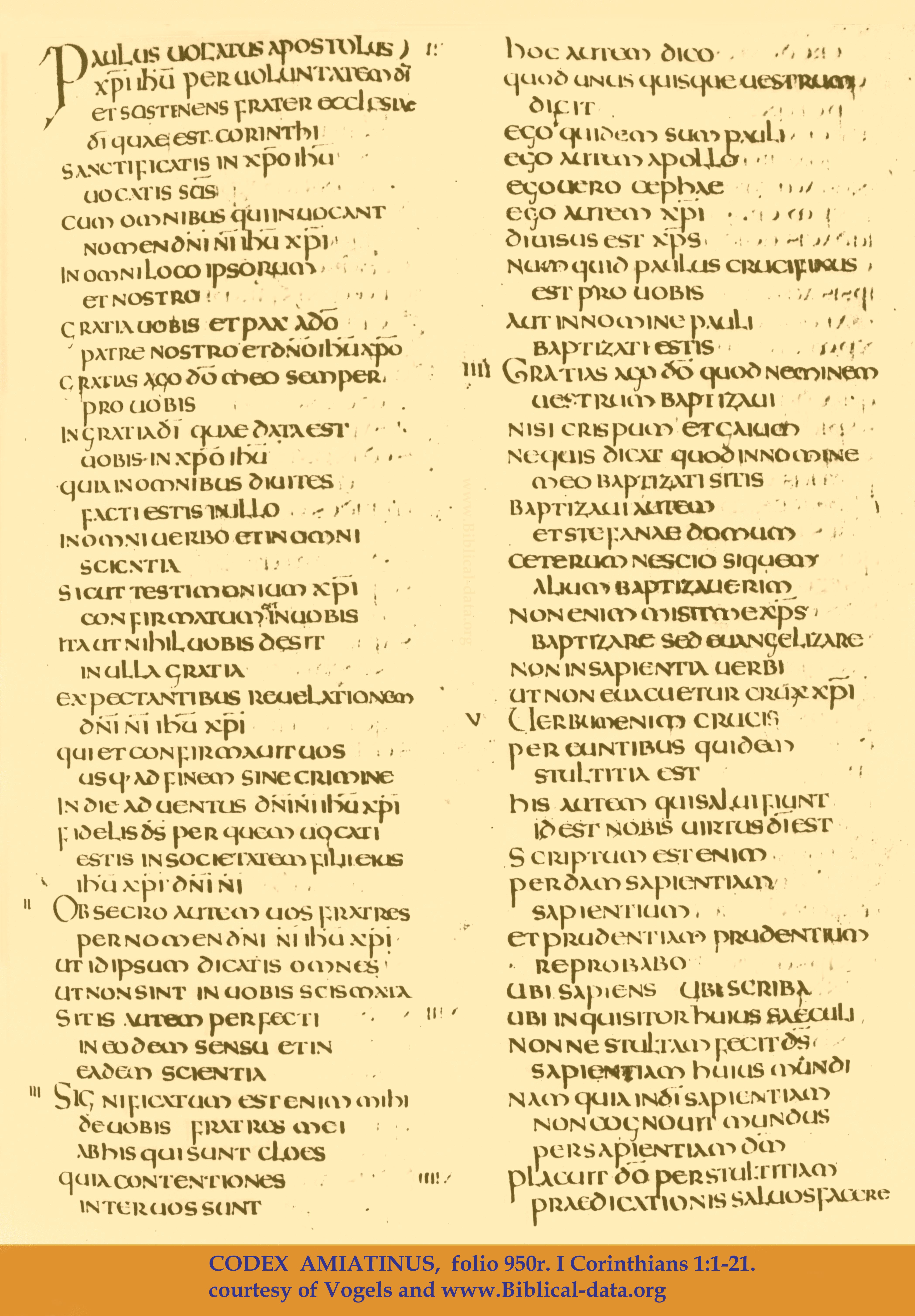
The script is written in uncial characters, large, clear, and regular, two columns to a page, and 43 or 44 lines to a column. A little space is generally left between words, although the writing often appears almost continuous.[8] The text is divided into sections, which in the Gospels correspond closely to the Ammonian Sections. There are no marks of punctuation, but the skilled reader was guided into the sense by stichometric, or verse-like, arrangement into cola and commata, which correspond roughly to the principal and dependent clauses of a sentence. From this manner of writing the script is believed to have been modeled upon the (vetus latina) Codex Grandior of Cassiodorus,[9] which Jarrow monastery possessed and may have been a model for illustrations and arrangement as well,[10] but it may go back, perhaps, even to St. Jerome.
History
Three copies of the Bible were originally commissioned by Abbot Ceolfrith in 692.[1] This date has been established as the double monastery of Monkwearmouth–Jarrow secured a grant of additional land to raise the 2000 head of cattle needed to produce the vellum. Bede was most likely involved in the compilation. De Hamel suggests that the pandects were prepared, possibly partly inscribed, and potentially corrected in a few places by Bede himself.[11] Bede's handwriting may be present.[12] In 716, Ceolfrith accompanied one copy, the Codex Amiatinus, intended as a gift to Pope Gregory II, but he died en route to Rome on 29 September 716 at Langres, Burgundy.[13][1] The book later appears in the ninth century in Abbazia di San Salvatore, Monte Amiata, in the March of Tuscany (hence the description "Amiatinus"), where it is recorded in a list of the Abbey's relics dated 1036, describing it as being an Old and New Testament "written in the hand of the blessed Pope Gregory".[7] It remained in the San Salvatore Monastery until 1786 when it passed to the Laurentian Library in Florence.
The dedication page had been altered and the principal librarian to the Laurentian, Angelo Maria Bandini suggested that the author was Servandus, a follower of St. Benedict, and that it had been produced at Monte Cassino around the 540s. This claim was accepted for the next hundred years, establishing it as the oldest copy of the Vulgate, but scholars in Germany noted the similarity to 9th-century texts. In 1888, Giovanni Battista de Rossi established that the Codex was related to the Bibles mentioned by Bede. This also established that Amiatinus was related to the Greenleaf Bible fragment in the British Library. Although de Rossi's attribution removed 150 years from the age of the Codex, it remains the oldest complete text of the Vulgate.
As the primary source of the Vulgate, the manuscript was of particular importance to the Catholics during the Counter-Reformation. Protestant translations derived from the original language of the Scriptures, but the Latin text of the Amiatinus was earlier than any then-known Hebrew manuscript, making it a "major piece of propaganda in the battle for textual precedence". In 1587 Pope Sixtus V demanded the book be sent to Rome where it was consulted for a new papal edition of the Bible, the Sixtine Vulgate;[7]: 64 although in the event, little or no use was made of its readings in either the Sistine or subsequent Sixto-Clementine official Vulgate editions, whose editors rather preferred later medieval Vulgate texts and editions now known to have been heavily corrupted by non-Vulgate readings.
In view of the many accumulated corruptions in all published editions of the Vulgate so far, the Oxford University Press accepted in 1878 a proposal from classicist John Wordsworth (later Bishop of Salisbury) to produce a new critical edition of the Vulgate New Testament.[14][15] This was eventually published as Nouum Testamentum Domini nostri Iesu Christi Latine, secundum editionem sancti Hieronymi (The Latin New Testament of our Lord Jesus Christ, according to the version of Saint Jerome) in three volumes between 1889 and 1954;[16] the Codex Amiatinus being a primary source for the entire text; which also followed this manuscript in presenting the text in sense lines, cola et commata without any other indication of punctuation. In 1907 Pope Pius X commissioned the Benedictine monks in Rome to prepare a critical edition of Jerome's Vulgate, entitled Biblia Sacra iuxta latinam vulgatam versionem (The Holy Bible according to the Latin Vulgate Version), which eventually emerged as a counterpart Old Testament to the Oxford New Testament, following largely the same critical principles, and according similar primary status to the Codex Amiatinus text (other than for the Psalms); and similarly deriving its layout, cola et commata from Amiatinus.[17] It is now kept at the Laurentian Library (shelf number Amiatino 1).
Textual characteristics
Codex Amiatinus Novum Testamentum Latine (Codex Amiatinus: Latin New Testament), prepared by Tischendorf, does not contain the Johannine Comma (1 John 5.7).[18]
See also
- List of New Testament Latin manuscripts
- Celt (tool) – a famous mistake in most Vulgates, not found in this copy
- Ceolfrid Bible – almost certainly a surviving portion of one of the other two single-volume Bibles ordered made by Ceolfrid for the double monastery of Monkwearmouth–Jarrow
- Codex Fuldensis
From the 1913 Catholic Encyclopedia
Codex Amiatinus — The most celebrated manuscript of the Latin Vulgate Bible, remarkable as the best witness to the true text of St. Jerome and as a fine specimen of medieval calligraphy, now kept at Florence in the Bibliotheca Laurentiana. The symbol for it is written am or A (Wordsworth). It is preserved in an immense tome, measuring in height and breadth 19 1/4 inches by 13 3/8 inches, and in thickness 7 inches -- so impressive, as Hort says, as to fill the beholder with a feeling akin to awe. Some consider it, with White, as perhaps "the finest book in the world"; still there are several manuscripts which are as beautifully written and have besides, like the Book of Kells or Book of Lindisfarne, those exquisite ornaments of which Amiatinus is devoid. It contains 1029 leaves of strong, smooth vellum, fresh-looking today, despite their great antiquity, arranged in quires of four sheets, or quaternions. It is written in uncial characters, large, clear, regular, and beautiful, two columns to a page, and 43 or 44 lines to a column. A little space is often left between words, but the writing is in general continuous. The text is divided into sections, which in the Gospels correspond closely to the Ammonian Sections. There are no marks of punctuation, but the skilled reader was guided into the sense by stichometric, or verse-like, arrangement into coda and commata, which correspond roughly to the principal and dependent clauses of a sentence. This manner of writing the scribe is believed to have modelled upon the great Bible of Cassiodorus (q.v.), but it goes back perhaps even to St. Jerome; it may be shown best by an example:
QUIA IN POTESTATE ERAT
SERMO IPSIUS
ET IN SYNAGOGA ERAT HOMO HABENS
DAEMONIUM INMUNDUM
ET EXCLAMAVIT VOCE MAGNA
DICENS
SINE QUID NOBIS ET TIBI IHU
NAZARENE VENISTI PERDERE NOS
SCIO TE QUI SIS SCS DI
ET INCREPAVIT ILLI IHS DICENS
It will be noticed that the section "ET IN" and the coda begin at about the same perpendicular line, the commata begin further in under the third or second letter, and so likewise does the continuation of a colon or comma which runs beyond a single line (see facsimile page). This arrangement, besides aiding the intelligence of the text, gave a spacious, varied, and rather artistic appearance to the page. The initial letter of a section was often written in ink of a different colour, and so also was the first line of a book. Beyond that there was no attempt at decorating the text.
The codex (or pandect) is usually said to contain the whole Bible; but it should be noted that the Book of Baruch is missing, though the Epistle of Jeremias, usually incorporated with it, is here appended to the Book of Jeremias. Besides the text of the Scriptural books, it contains St. Jerome's "Prologus Galeatus" and his prefaces to individual books; the capitula, or summaries of contents; and, in the first quaternion, certain materials which have been much discussed and have proved of the greatest service in tracing the history of the codex, among them dedicatory verses, a list of the books contained in the codex, a picture of the Tabernacle (formerly thought to be Solomon's Temple), a division of the Biblical books according to Jerome, another according to Hilary and Epiphanius, and a third according to Augustine. Part of Solomon's prayer (III K., viii, 22-30) in an Old Latin text is reproduced at the end of Ecclesiasticus. A Greek inscription at the beginning of Leviticus, recording that "the Lord Servandus prepared" this codex or part of it, has entered largely into the discussion of its origin.
The recovery of the history of Codex Amiatinus, which has important bearings upon the history of the Vulgate itself and of the text of the Bible, was due to the labours of many scholars and the insight of one man of genius, de Rossi. At the beginning of the pandect, as we have mentioned, there are certain dedicatory verses; they record the gift (of the codex) to the venerable convent of St. Saviour by a certain Peter who was abbot from the extreme territory of the Lombards. The Latin text is as follows:
CENOBIUM AD EXIMII MERITO
VENERABILE SALVATORIS
QUEM CAPUT ECCLESIAE
DEDICAT ALTA FIDES
PETRUS LANGOBARDORUM
EXTREMIS DE FINIB. ABBAS
DEVOTI AFFECTUS
PIGNORA MITTO MEI
St. Saviour's is the name of the monastery on Monte Amiata (whence Amiatinus) near Siena; here this codex was kept from the ninth century till the year 1786, when it was brought to Florence after the suppression of the monastery. Naturally, the codex was supposed to be a gift to this house, but nothing was known of the donor. Bandini, the librarian of the Laurentiana, into whose hands the codex came, noticed that the names of neither the donor nor the recipient belonged to the original dedication. They were written in a different hand over parts of the original inscription, as betrayed by evident signs of erasure. The letters italicized above were by the second hand, while the initial letter C of the first line and the E in the fifth were original. Bandini noticed, also, that cenobium replaced a shorter word and that the last five letters of salvatoris were written on parchment that had not been erased, and so that the ten letters of this word replaced five of the original word. The metre also was entirely at fault. The clue for reconstructing the original lines he found in the expression caput ecclesiæ, which he judged referred to St. Peter. And as in the Middle Ages a favourite title for the Apostolic See was culmen apostolicum, he reconstructed the line in this fashion:
CULMEN AD EXIMII MERITO VENERABILE PETRI
This conjecture produced a correct hexameter verse, retained the original initial C, supplied a word of proper length at the beginning and another at the end, and afforded a sense fitting in perfectly with the probabilities of the case. In the fifth line, instead of Petrus Langobardorum, Bandini suggested Servandus Latii, because of the inscription about Servandus mentioned above. This Servandus was believed to be a friend of St. Benedict, to whom he made a visit at Monte Cassino in 541; he was abbot of a monastery near the extremity of Latium.
These conjectures were accepted by the learned world; Tischendorf, for instance, writing seventy-five years later, said Bandini had so well proved his case that no doubt remained. Accordingly, it was settled that the Codex Amiatinus dated from the middle of the sixth century, was the oldest manuscript of the Vulgate, and was written in Southern Italy. A few protests were raised, however; that, for instance, of Paul de Lagarde. He had edited St. Jerome's translation of the Hebrew Psalter, using freely for that purpose a codex of the ninth century; Amiatinus he judged, with a not unnatural partiality, to be "in all probability" from the hand of the scribe of his ninth-century Psalter, written "at Reichenau on the Lake of Constance". But, to quote Corssen, it was G. B. de Rossi, "that great Roman scholar, whose never-failing perspicacity and learning discovered at once the birthplace of our famous manuscript" (Academy, 7 April, 1888).
De Rossi followed Bandini in his reconstruction of the first verse, but he thought it unlikely that an abbot, presenting a book to the pope at Rome, should speak of "the extreme limits of Latium", really but a short distance from Rome. Anzizni, the librarian of the Laurentiana, pointed out to him that the space erased to make room for Petrus Langobardorum was greater than called for by the conjecture of Bandini. De Rossi was at the time engaged on an inquiry into the ancient history of the Vatican library, and, recalling a passage of Bede, he divined that the lost name was Ceolfridus. The erasures, which were irregular, seeming to follow the letters very closely, corresponded perfectly to this conjecture. He proposed then the verse:
CEOLFRIDUS BRITONUM EXTREMIS DE FINIB. ABBAS
The phrase exactly suited an abbot from the end of the world, as England was then regarded and styled; and the story of Ceolfrid made de Rossi's conjectures acceptable at once, especially to English scholars. Ceolfrid was the disciple of Benedict Biscop (q.v.), who founded the monasteries of Wearmouth and Jarrow in Northumberland towards the end of the seventh century. England, in those days, was the most devoted daughter of the Roman See, and Abbot Benedict was enthusiastic in his devotion. His monasteries were dependent directly on Rome. Five times during his life he journeyed to Rome, usually bring back with him a library of books presented by the pope. Ceolfrid, who had accompanied him on one of these visits, became his successor in 686 and inherited his taste for books; Bede mentions three pandects of St. Jerome's translation which he had made, one of which he determined in his old age, in 716, to bring to the church of St. Peter at Rome. He died on the way, but his gift was carried to the Holy Father, then Gregory II. This codex de Rossi identified with Amiatinus.
This conjecture was hailed by all as a genuine discovery of great importance. Berger, however, objected to Britonum, suggesting Anglorum. Hort soon placed the matter beyond the possibility of doubt. In an anonymous life of Ceolfrid, the chief source of Bede's information, which, though twice published, had been overlooked by all, Hort found the story of Ceolfrid journeying to Rome and carrying the pandect inscribed with the verses:
CORPUS AD EXIMII MERITO VENERABILE PETRI
DEDICAT ECCLESIAE QUEM CAPUT ALTA FIDES
CEOLFRIDUS, ANGLORUM EXTIMIS DE FINIBUS ABBAS
etc. Despite the variations, there could be no doubt of their identity with the dedicatory verses of Amiatinus; Corpus was of course the original, not Culmen, and Anglorum, not Britonum; the other differences were perhaps due to a lapse of memory, or this version may represent the original draft of the dedication. De Rossi's chief point was proved right. It established that Amiatinus originated in Northumberland about the beginning of the eighth century, having been made, as Bede states, at Ceolfrid's order. It does not follow, however, that the scribe was an Englishman; the writing and certain peculiarities of orthography have led some to believe him an Italian. We know that these two monasteries had brought over a Roman musician to train the monks in the Roman chant, and they may also, for a similar purpose, have procured from Italy a skilled calligrapher. The handwriting of Amiatinus bears a strong resemblance to some fragments of St. Luke in a Durham manuscript, to New Testament fragments bound up with the Utrecht Psalter, and to the Stonyhurst St. John; these facts, together with Bede's statement that Ceolfrid had three pandects written, indicate that "there was a large and flourishing school of calligraphy at Wearmouth or Jarrow in the seventh and eighth centuries, of which till lately we had no knowledge at all" (White). This conclusion is confirmed by peculiarities in the text and in certain of the summaries. The contents of the first quaternion of Amiatinus coincide so remarkably with descriptions of the celebrated Codex Grandior of Cassiodorus that it has been supposed that the leaves were transferred from it bodily; the conjecture has been rendered more credible by the fact that this codex was actually seen in England by Bede, perhaps before Amiatinus was carried to Rome. Moreover, the contents of our codex do not correspond exactly to the list prefixed which purports to give the contents. These reasons, however, would only prove that the Codex Grandior served as the model, which seems indubitable; while, on the other hand, weighty reasons have been urged against the other attractive hypothesis (see White and de Rossi).
Despite the lowering of its date by a century and a half, Amiatinus holds the first place for purity of text among the manuscripts of the Vulgate. Its excellence is best explained on the ground that its prototype was an ancient Italian manuscript, perhaps one of those brought from Rome by Benedict Biscop, perhaps one brought by Adrian, abbot of a monastery near Naples, when in 668 he accompanied Benedict and Theodore to England. It is remarkable that Amiatinus and the other Northumbrian codices are nearest in text to Italian manuscripts, especially to Southern Italian, and to manuscripts betraying Italian descent. The group to which it belongs bears the closest relationship to the best-esteemed Greek manuscripts extant, aleph, B. (Cf. MANUSCRIPTS OF THE BIBLE; CRITICISM, BIBLICAL, sub-title Textual.) In the Old Testament, the text is not of equal purity throughout; Berger, e.g., notes the inferiority of Wisdom and Ecclesiasticus, and Tischendorf of Machabees. The Psalter does not present the Vulgate text, but St. Jerome's translation from the Hebrew (cf. PSALTER; VULGATE). The excellence of the Amiatine text is not a new discovery: it was well known to the Sixtine revisers of the Vulgate, who used it constantly and preferred it, as a rule, to any other. To this is largely due the comparative purity of the official Vulgate text and its freedom from so many of the corruptions found in the received Greek text, which rests, as is well known, on some of the latest and most imperfect Greek manuscripts.
WHITE, The Codex Amiatinus and Its Birthplace in Studia Biblica (Oxford, 1890), II; WORDSWORTH AND WHITE, Novum Testamentum Latine (Oxford, 1890); DE ROSSI, La Bibbia Offerta da Ceolfrido (Rome, 1887, containing a photographic facsimile of the dedicatory verses); BERGER, Histoire de la Vulgate (Paris, 1893); BATIFFOL in VIGOUROUX, Dict. de la Bible (Paris, 1892), s.v. Amiatinus, with facsimile of part of a page of St. Luke. A series of letters to the Academy, 1886-89, by WORDSWORTH, HORT, CORSSEN, SANDAY, HAMANN, BROWNE, etc., constitute the most exhaustive discussion. The text of the N.T. was published by TISCHENDORF (1850, 1854) and by TREGELLES (1857); O.T. not yet published but collated in HEYSE AND TISCHENDORF, Biblia Latina (Leipzig, 1873). The Palæographical Society has published two facsimile pages.
References
- Back to citation occurrence 1.0 Back to citation occurrence 1.1 Back to citation occurrence 1.2 Metzger, Bruce Manning; Ehrman, Bart D. (2005). The Text of the New Testament: Its Transmission, Corruption and Restoration (4th ed.). Oxford: Oxford University Press. p. 106. ISBN 0-19-516667-1.
- Back to citation Bogaert, Pierre-Maurice (2005). "Le livre de Baruch dans les Manuscrits de la Bible Latine: Disparition et Réintégration" [The Book of Baruch in the Latin Bible Manuscripts: Disappearance and Reintegration]. Revue Bénédictine. 115 (2): 286–342. doi:10.1484/J.RB.5.100598.
- Back to citation Weber, Robert; Gryson, Roger, eds. (2007). Biblia Sacra iuxta vulgatam versionem [The Holy Bible: Latin Vulgate Version] (in Latin) (5 ed.). Stuttgart: Deutsche Bibelgesellschaft. ISBN 978-3-438-05303-9.
- Back to citation Gallagher, Edmon L; Meade, John. D., eds. (2017). The Biblical Canon Lists of Early Christianity. Oxford: Oxford University Press. p. 258.
- Back to citation H. J. White, The Codex Amiatinus and its Birthplace, in: Studia Biblica et Ecclesiasctica (Oxford 1890), Vol. II, p. 273.
- Back to citation Marsden, Richard (2001). "Amiatinus, Codex". In Lapidge, Michael; Blair, John; Keynes, Simon; Scragg, Donald (eds.). The Blackwell Encyclopaedia of Anglo-Saxon England (1st ed.). West Sussex: John Wiley & Sons. p. 31. ISBN 978-0-47065632-7.
- Back to citation occurrence 7.0 Back to citation occurrence 7.1 Back to citation occurrence 7.2 De Hamel, Christopher (2017). Meetings with Remarkable Manuscripts. Penguin. pp. 68, 82, 61. ISBN 978-1594206115.
- Back to citation occurrence 8.0 Back to citation occurrence 8.1 Gameson, Richard (2017). Codex Amiatinus: Making and Meaning (Jarrow Lecture 2017). PCC of St Paul's Church, Jarrow. pp. 8, 20–22. ISBN 978-1-909517-26-4.
- Back to citation John Chapman, The Codex Amiatinus and the Codex grandior in: Notes on the early history of the Vulgate Gospels, Clarendon Press, Oxford 1908, pp. 2–8.
- Back to citation Meyvaert, Paul (1996). "Bede, Cassiodorus, and the Codex Amiatinus". Speculum. 71 (4): 827–883. doi:10.2307/2865722. ISSN 0038-7134.
- Back to citation de Hamel, Christopher. Meetings with Medieval Manuscripts. pp. 91–93.
- Back to citation A smoking quill? Notes in Bible margin could be handwriting of the Venerable Bede - Tim Dowling, The Guardian Newspaper
- Back to citation Hind, George. "St. Ceolfrid." The Catholic Encyclopedia. Vol. 3. New York: Robert Appleton Company, 1908. 17 May 2013
- Back to citation Wordsworth, John (1883). The Oxford Critical Edition of the Vulgate New Testament. Oxford: Oxford University Press. p. 4.
- Back to citation Watson, E.W. (1915). Life of Bishop John Wordsworth. London: Green Longmans.
- Back to citation Wordsworth, John; White, Henry Julian, eds. (1889–1954). Nouum Testamentum Domini nostri Iesu Christi Latine, secundum editionem sancti Hieronymi [The Latin New Testament of our Lord Jesus Christ, according to the version of Saint Jerome] (in Latin). Oxford: Clarendon Press. 3 vols,
- Back to citation Pontifical Abbey of St Jerome-in-the-City (1926–1995). Biblia Sacra iuxta latinam vulgatam versionem [The Holy Bible: Latin Vulgate Version] (in Latin). Rome: Libreria Editrice Vaticana. ISBN 978-8820921286. 18 vols.
- Back to citation von Tischendorf, Constantin (1854). Codex Amiatinus Novum Testamentum Latine [Codex Amiatinus: Latin New Testament] (in Latin). Leipzig: Avenarius et Mendelssohn. p. 391.
Further reading
- Chapman, John (1908). Notes on the early history of the Vulgate Gospels. Oxford: Clarendon Press. Retrieved 2015-12-13.
- Chazelle, Celia (2003). "Ceolfrid's gift to St Peter: the First Quire of the Codex Amiatinus and the Evidence of its Roman Destination". Early Medieval Europe. 12 (2): 129–157. doi:10.1111/j.0963-9462.2004.00124.x. ISSN 1468-0254. S2CID 161636760.
- Chazelle, Celia (2006). "Christ and the Vision of God: the Biblical Diagrams of the Codex Amiatinus". In Hamburger, Jeffrey F; Bouché, Anne-Marie (eds.). The Mind's Eye: Art and Theological Argument in the Middle Ages. Princeton, NJ: Princeton University Press. pp. 84–111. ISBN 978-0-691-12475-9.
- Corsano, Karen (1987). "The First Quire of the Codex Amiatinus and the Institutiones of Cassiodorus". Scriptorium. 41 (1): 3–34. doi:10.3406/scrip.1987.1462. ISSN 0036-9772.
- Meyvaert, Paul (1996). "Bede, Cassiodorus, and the Codex Amiatinus". Speculum. 71 (4): 827–883. doi:10.2307/2865722. ISSN 0038-7134. JSTOR 2865722. S2CID 162009695.
- Meyvaert, Paul (2005). "The date of Bede's In Ezram and his image of Ezra in the Codex Amiatinus". Speculum. 80 (4): 1087–1133. doi:10.1017/S0038713400001366. ISSN 2040-8072. S2CID 162822236. Retrieved 2015-12-04.
- Sanday, W. (1890). "On the Italian Origin of the Codex Amiatinus and the Localizing of Italian MSS.". Studia Biblica et ecclesiastica: Essays Chiefly in Biblical and Patristic Criticism. Vol. 2. Oxford: Clarendon Press. pp. 309–324.
- Tischendorf, Constantinus von (1850). Novum Testamentum Latine interprete Hieronymo: ex celeberrimo Codice Amiatino [The Latin New Testament, translated by Jerome: From the most famous Codex Amiatinus] (in Latin). Leipzig: Avenarius et Mendelssohn. Retrieved 2015-12-04.
- White, H.J. (1890). "The Codex Amiatinus and its birthplace". Studia Biblica et ecclesiastica: essays chiefly in Biblical and patristic criticism. Vol. 2. Oxford: Clarendon Press. pp. 273–308.
- The City and the Book: International Conference Proceedings, Florence, 2001.
- Alphabet and Bible: From the Margins to the Centre. Paper at Monte Amiata, 2009. https://web.archive.org/web/20090803165921/http://www.florin.ms/AlphabetBible.html
- Makepeace, Maria. "The 1,300 year pilgrimage of the Codex Amiatinus". Umilta Website. Retrieved 2006-06-07. Contains link to facsimile project, as well.
External links
- Codex Amiatinus: Complete images through the World Digital Library
- Codex Amiatinus: Complete images from the Laurentian Library (BML / Biblioteca Medicea Laurenzina) Online Digital Library
- Florence, Biblioteca Medicea Laurenziana, Amiat. 1, bibliography
- Image of the codex, folio 950
- British Library blogpost
- David Dimbleby. "Age of Conquest". Seven Ages of Britain. 33:38 minutes in. BBC 1. Retrieved 21 Nov 2010.
- The Cambridge History of the Bible Archived 2012-11-09 at the Wayback Machine, Cambridge University Press 2008, pp. 117–119, 130.
- More information at Earlier Latin Manuscripts.