

Ferdinand Verbiest
| The Reverend Ferdinand Verbiest SJ | |
|---|---|

Portrait of Ferdinand Verbiest
| |
| Born | 9 October 1623 Pittem, Tielt, County of Flanders, Spanish Netherlands |
| Died | 28 January 1688 (aged 64) Beijing, Qing Dynasty |
| Resting place | Zhalan Cemetery, Beijing |
| Occupation | Jesuit missionary |
Ferdinand Verbiest SJ (9 October 1623 – 28 January 1688) was a Flemish Jesuit missionary in China during the Qing dynasty. He was born in Pittem near Tielt in the County of Flanders (now part of Belgium).[1] He is known as Nan Huairen (南懷仁) in Chinese.
He was an accomplished mathematician and astronomer and proved to the court of the Kangxi Emperor that European astronomy was more accurate than Chinese astronomy. He then corrected the Chinese calendar and was later asked to rebuild and re-equip the Beijing Ancient Observatory, being given the roles of Head of the Mathematical Board and Director of the Observatory.
He became close friends with the Kangxi Emperor, who frequently requested his instruction in geometry, philosophy and music. Verbiest worked as a diplomat, cartographer, and translator; he spoke Latin, German, Dutch, Spanish, Hebrew, Italian and Manchu. He wrote more than thirty books.
During the 1670s, Verbiest designed what some claim to be the first ever self-propelled vehicle, in spite of its small size, not being able to carry a driver or goods, and the lack of evidence that it was actually built. He died in 1688. He was granted the posthumous name "Qínmǐn" (勤敏) by Kangxi Emperor.[2]
Early life
Ferdinand Verbiest was the eldest child of Joos Verbiest, a bailiff and tax collector of Pittem near Kortrijk, Belgium.[3] Verbiest studied humanities with the Jesuits, in Bruges and Kortrijk, and next went to the Lelie College in Leuven for a year to study philosophy and mathematics.[3] He joined the Society of Jesus (Jesuits) on 2 September 1641.[1] Verbiest continued studying theology in Seville, where he was ordained as a priest in 1655.[1] He completed his studies in astronomy and theology in Rome.[3] His intention had been to become a missionary in the Spanish missions to Central America, but this was not to be. His call was to the Far East, where the Roman Catholic Church was 'on a mission' to compensate for the loss of (Catholic) believers to the emerging Protestantism in Europe.[3]
On 4 April 1657, Verbiest left for China from Lisbon, accompanied by Father Martino Martini, thirty-five other missionaries, the Portuguese Viceroy of the Indies and some other passengers. Their boat reached Macau on 17 July 1658, by which time all but ten of the passengers, including the Viceroy and most of the missionaries, had died.[4] Verbiest took up his first posting in Shaanxi, leading the mission until 1660 when he was called to assist – and later replace – Father Johann Adam Schall von Bell, the Jesuit Director of the Beijing Observatory and Head of the Mathematical Board, in his work in astronomy. Unfortunately for them, the political situation shifted dramatically in 1661, after the death of the young Shunzhi Emperor aged 23. His son and successor, Xuanye (the Kangxi Emperor), was only 7, so the government was placed in the hands of four regents. Unlike Shunzhi, the regents were not in favour of the Jesuits,[4] who suffered increased persecution as a result.
Astronomy contests
In 1664, the Chinese astronomer Yang Guangxian (1597–1669), who had published a pamphlet against the Jesuits, challenged Schall von Bell to a public astronomy competition. Yang won and took Schall von Bell's place as Head of Mathematics. Having lost the competition, Schall von Bell and the other Jesuits were chained and thrown into a filthy prison, accused of teaching a false religion. They were bound to wooden pegs in such a way that they could neither stand nor sit and remained there for almost two months until a sentence of strangulation was imposed. A high court found the sentence too light and ordered them to be cut up into bits while still alive.[5] Fortunately for them, on 16 April 1665,[6] a violent earthquake destroyed the part of the prison chosen for the execution. An extraordinary meteor was seen in the sky, and a fire destroyed the part of the imperial palace where the condemnation was pronounced.[7] This was seen as an omen and all the prisoners were released. However, they still had to stand trial, and all the Jesuits but Verbiest, Schall von Bell and two others were exiled to Canton. Schall von Bell died within a year, due to the conditions of his confinement.[4]
In 1669, the Kangxi Emperor managed to take power by having the last remaining corrupt regent Oboi arrested. In the same year, the emperor was informed that serious errors had been found in the calendar for 1670, which had been drawn up by Yang Guangxian. Kangxi commanded a public test to compare the merits of European and Chinese astronomy. The test was to predict three things: the length of the shadow thrown by a gnomon of a given height at noon of a certain day; the absolute and relative positions of the Sun and the planets on a given date; and the exact time of an anticipated lunar eclipse. It was decided that Yang and Verbiest should each use their mathematical skills to determine the answers and that "The Heavens would be the judge". The contest was held at the Bureau of Astronomy in the presence of senior-ranking government ministers and officials from the observatory. Unlike Yang, Verbiest had access to the latest updates on the Rudolphine Tables, and was assisted by telescopes for observation. He succeeded in all three tests and was immediately installed as the Head of the Mathematical Board and Director of the Observatory. Out of consideration for him, the exiled Jesuits were authorized to return to their missions. Meanwhile, Yang was sentenced to the same death he had planned for his Jesuit rival, but the sentence was reduced to exile and he died en route to his native home.[8]
Initial projects
The 1670 calendar included an extra month unnecessarily added to hide other errors and to bring the lunar months in line with the solar year. Verbiest suggested the errors should be corrected, including removing the extra month. This was an audacious move, as the calendar had been approved by the emperor himself. Fearing the emperor's response, the observatory officials begged him to withdraw this request, but he responded: "It is not within my power to make the heavens agree with your calendar. The extra month must be taken out." Much to their surprise, the emperor, after studying the research, agreed, and it was done.[5]
After this, Verbiest and the emperor formed a real friendship, with the Jesuit teaching him geometry, philosophy and music. He was frequently invited to the palace and to accompany the Emperor on his expeditions throughout the empire. He translated the first six books of Euclid into Manchu and took every opportunity to introduce Christianity. In response, the Emperor elevated him to the highest grade of the mandarinate and granted permission for him to preach Christianity anywhere in the empire.[5]
Verbiest undertook many projects, including the construction of an aqueduct, the casting of 132 cannons for the imperial army – far superior to any previous Chinese weapons – and the design of a new gun carriage. He created star charts for the Kangxi Emperor in order to tell the time at night.[9] Other inventions included a steam engine to propel ships.
Instruments for Beijing Observatory
Having resolved the issues surrounding the calendar, Verbiest went on to compose a table of all solar and lunar eclipses for the next 2000 years. Delighted with this, the emperor awarded him complete charge of the imperial astronomy observatory, which he rebuilt in 1673. The existing equipment was obsolete, so Verbiest consigned it to a museum and set about designing six new instruments:[5]
- Altazimuth, used to measure the position of celestial bodies relative to the celestial horizon and the zenith – the altitude azimuth.[10]
- Celestial globe, six feet in diameter, used to map and identify celestial objects.[11] A copy donated by the Chinese government is on display at the Ferdinand Verbiest Institute[12] of the Katholieke Universiteit Leuven in Belgium.
- Ecliptic armilla, armillary sphere, six feet in diameter, used to measure the ecliptic longitude difference and latitudes of celestial bodies. This was the traditional European device while the Chinese had developed the equatorial armilla.[13]
- Equatorial armilla, armillary sphere, six feet in diameter, used primarily for measuring true solar time as well as right ascension difference and declination of celestial bodies.[14]
- Quadrant Altazimuth, six feet in radius, for measuring altitudes or zenith distances of celestial bodies.[15]
- Sextant, eight feet in radius, used to measure the angle of elevation of a celestial object above the horizon. It is used to calculate the angle between two objects, although it is limited to 60 degrees of arc. In navigation, it is used to take a measure of the angle of the Sun at noon to determine latitude.[16]
These instruments were all very large, made of brass and highly decorated, with bronze dragons forming the supports. Despite their weight, they were very easy to manipulate, demonstrating Verbiest's aptitude for mechanical design.
Final days and death
Verbiest died in Beijing shortly after receiving a wound from falling off a bolting horse.[17] He was succeeded as the chief mathematician and astronomer of the Chinese empire by another Belgian Jesuit, Antoine Thomas (1644–1709). He was buried in the Jesuits' Zhalan Cemetery in Beijing, near those of other Jesuits including Matteo Ricci and Johann Adam Schall von Bell, on 11 March 1688.[5]
Verbiest was the only Westerner in Chinese history to ever receive the honour of a posthumous name by the Emperor.
Verbiest's "car"
Besides his work in astronomy, Verbiest also experimented with steam. Around 1672, he designed – as a toy for the Kangxi Emperor – a steam-propelled trolley which was, quite possibly, the first working steam-powered vehicle ("auto-mobile").[18] Verbiest describes it in his manuscript Astronomia Europea[19] that was finished in 1681. A friar brought it to Europe and it was then printed in 1687 in Germany. In this work, Verbiest first mentioned the (Latin) term motor in its present meaning. With one filling of coal, he wrote that the vehicle was able to move more than one hour.[20] As it was only 65 cm (25.6 in) long, and therefore effectively a scale model, not designed to carry human passengers, nor a driver or goods, it is not strictly accurate to call it a 'car'.[21] Despite this, it was the first vehicle that was able to move by 'self-made' engine power.
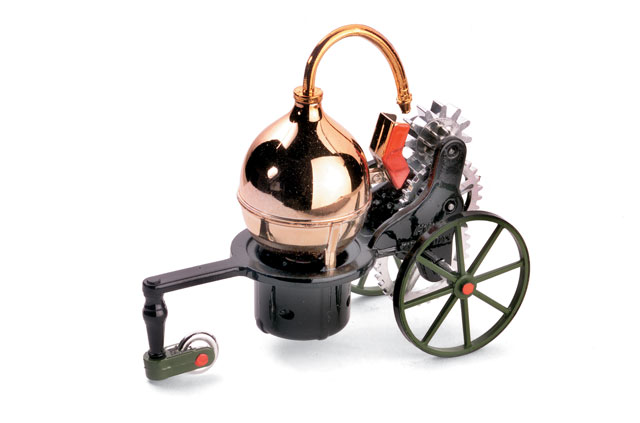
Since the steam engine was still not known at that time, Verbiest used the principle of an impulse turbine. Steam was generated in a ball-shaped boiler, emerging through a pipe at the top, from where it was directed at a simple, open "steam turbine" (rather like a water wheel) that drove the rear wheels.
It is not verified by other known sources if Verbiest's model was ever built at the time and no authentic drawing of it exists, although he had access to China's finest metal-working craftsmen who were constructing precision astronomical instruments for him.
Students of the Technische Hochschule Ingolstadt in 2021 built an original model according to the description in the Astronomia Europea. Only design options that were feasible at the time were considered (apart from the steam tank, which for safety reason had a pressure valve). The pressure tank was heated with coal and travelled several metres.[22] The replica demonstrated that the concept was technically feasible.[23] A model of this first ‘Auto Mobile’ is on display at the Autoworld Museum in Brussels.
The Brumm model
The Italian model manufacturer Brumm produced a non-working 1:43 scale model of the Veicolo a turbina de Verbiest (1681) [sic],[24] in their "Old Fire" range of 2002. This model was 9 cm (3.54 in) long, which, when scaled-up, would have suggested that Verbiest's original would have been nearly 4 metres (13 ft 1 in) in length.
However, comparison with drawings in Hardenberg's study shows that this model is not the same as Verbiest's. It is actually modelled on a small steam turbine car built in the late 18th century (presumably 1775) by a German mechanic that was inspired by Verbiest's vehicle but different, for example, only with three wheels.[20] Unfortunately, the original was probably destroyed during a bombing raid on the Technische Hochschule Karlsruhe during World War II. However, a photo of the original car can be seen at the Deutsches Museum. Hardenberg notes that this steam turbine car operated on the same principle as Verbiest's carriage (the impulse turbine), but employed a more modern arrangement of the drive train.[25]
Major works
- In Chinese
- 仪象志 (Yixiang zhi), 1673 (on astronomical instruments and apparatus) [26][27]
- 康熙永年历法 (Kangxi yongnian lifa), 1678 (on the calendar of the Kangxi Emperor)
- 方言教要序论 (Jiaoyao xulun) (explanation of the basics of the faith)
- Latin
Memorials
Verbiest is commemorated on several postage stamps. One, featuring his face, was issued in Belgium on 24 October 1988, to mark the tri-centenary of his death,[28] with a matching pictorial cancellation postmark.[29] Several more stamps were issued in Macau, in 1989 and 1999, featuring a sketch by Verbiest of the Observatory in Peking, where he worked.[28] The Chevalier Medal for Oriental Art was instituted in his memory to reward exceptional contributions to the sciences and arts.
See also
- Christianity in China
- History of steam road vehicles
- Jesuit China missions
- List of Roman Catholic scientist-clerics
- Religion in China
- Roman Catholicism in China
From the 1913 Catholic Encyclopedia
Ferdinand Verbiest — Missionary and astronomer, b. at Pitthem near Coutrai, Belgium, 9 Oct., 1623; d. at Peking, 28 January, 1688. He entered the Society of Jesus on 2 Sept., 1641, and studied theology at Seville, where he defended public theses in 1655. In 1658 with thirty-five new missionaries he accompanied Father Martin Martini on his return to China after having secured at Rome the Decree of Alexander VII for the toleration of the Chinese rites (see RICCI, MATTEO). He reached Macao in 1659, and was exercising his ministry in Shen-si when in 1660 he was called to Peking to assist, and eventually to replace, Father Adam Schall in his astronomical labours. He was among those imprisoned during the persecution of 1664. Father Schall, the chief of those accused, being unable to make himself understood by his judges, Father Verbiest, himself loaded with nine chains, defended him with courage and eloquence. In fact the Church in China owed to Father Verbiest the recovery of peace and greater security than it had before the outbreak. In 1668 the young emperor commanded a public test, which allowed the priest to prove beyond dispute the merits of European astronomy compared with the ancient astronomy of China. Father Verbiest and the mandarin who had instigated the persecution and who had taken Father Schall's place as president of the bureau of mathematics, were each commissioned to determine in advance the length of the shadow thrown by a gnomon of a given height at noon of a certain day; then the absolute and relative positions of the sun and the planets on a given date; and finally the moment of a lunar eclipse. The results of the test, which the emperor, ministers, and nobles established in person, were a triumph for the astronomy for the missionaries. Father Verbiest was immediately placed at the head of the Bureau of Mathematics, and, out of consideration for him, his exiled brethren were authorized to return to their missions.
Thenceforth K'ang-hi's benevolence towards Father Verbiest and the Christian religion increased steadily. The emperor requested the priest to construct instruments like those of Europe, and in May, 1674, Verbiest was able to present him with six, made under his direction: a quadrant, six feet in radius; an azimuth compass, six feet in diameter; a sextant, eight feet in radius; a celestial globe, six feet in diameter; and two armillary spheres, zodiacal and equinoctial, each six feet in diameter. These large instruments, all of brass and with decorations which made them notable works of art, were, despite their weight, very easy to manipulate, and a credit to Verbiest's mechanical skill as well as to his knowledge of astronomy and mathematics. They are still in a perfect state of preservation, and at the time of the expedition against the Boxers (1900) the international troops admired them on the platform of a tower of the imperial palace where Father Verbiest installed them more than two centuries and a half ago. K'ang-hi made use of the talents of the Belgian Jesuit in various other ways, e.g. the transportation of enormous blocks of stone, the construction of an aqueduct, and the casting of canons. Not only did Father Verbiest cast 132 cannons of far superior power than those possessed by the Chinese, but he invented a new gun- carriage.
At the same time the missionary had to write in Chinese a collection of works explaining the construction of the instruments, their object, and the manner of using them. The emperor also desired him to compile astronomical tables indicating the movements of the planets and the solar and lunar eclipses for 2000 years to come; moreover, he had him give on certain days a course in mathematics and astronomy, at which many of the great mandarins as well as the 160 students of the Bureau of Mathematics assisted. In his desire to acquire the European sciences, K'ang-hi himself became a pupil of the missionary; for five whole months he summoned him almost daily to his presence, setting aside in his behalf all the laws of Chinese etiquette and detaining him for whole days, while Father Verbiest explained the astronomical books compiled in Chinese by himself and his fellow-religious, and finally studying like a school-boy under his direction arithmetic, rectilinear and spherical geometry, geodesy, topography, etc. On beholding the earnestness with which K'ang-hi endeavoured to learn especially the chart of the heavens, Father Verbiest began to hope that "as a star of old brought the magi to the adoration of the true God, so the princes of the Far East through knowledge of the stars would be brought to recognize and adore the Lord of the stars". K'ang-hi did not fulfil this hope, but his bent for the European sciences, by inclining him to favour more and more the missionaries who made them known to him, became the means of salvation for thousands of his subjects. Through his influence with the emperor Father Verbiest did more for the spread of the Gospel than any of the missionaries who preached it in the provinces; nevertheless he found time for the direct exercise of the apostolate, especially in the composition of short works in Chinese on the principles of the Christian religion. As he says in one of his letters, books which the Chinese always welcomed as gifts, and which were especially esteemed coming from his pen, were a means of conveying the truth to persons to whom the missionaries would otherwise not have access. K'ang-hi recognized the services of the missionary by conferring on him successively the highest degrees of the mandarinate. The liberty to preach, the only reward Father Verbiest looked for, was almost the sole benefit he derived from his dignities.
It would seem that the use of the human sciences, which had so powerfully assisted Father Ricci to found the Chinese mission, and permitted Father Verbiest to save it, would henceforth not be misrepresented. But such was not the case, and, as is well known, it was a missionary from China who considered it his duty to carry to Rome, and by means of his writings to spread throughout the world, impassioned accusations against the methods of the Jesuit missionaries. Among the replies elicited by the attack of Father Navarrete there is one by Father Verbiest; it was not published, but was read at Rome and thence came an ample justification of the worthy missionary astronomer. Innocent XI, to whom he had dedicated the Chinese translation of the Missal printed at Peking and another work containing his astronomical observations, answered him on 3 December, 1681, by a Brief which means much more than a commonplace expression of thanks: "It has pleased us especially", says the pope, "to learn from your letter with what wisdom and seasonableness (quam sapienter atquie opportune) you have made use of the profane sciences for the salvation of the Chinese peoples and the advancement and benefit of the Christian faith: employing them to repel the false accusations and calumnies which have been heaped upon the Christian name, opening the way to that high degree of favour with the Chinese king and his advisers, which has obtained both that you yourself should be delivered from the harsh persecutions which you have long endured with the greatest courage, and the power to recall your fellow-missionaries from exile and to restore to religion not only its former liberty and splendour, but to inspire it with the hope of daily progress..."
In 1677 Father Verbiest was appointed vice provincial, i.e. superior of all the Jesuit missions of China. This nomination was a stimulus to seek new means of developing the work confided to his direction, with which object he addressed (15 Aug., 1678) a circular letter to all the members of his order in Europe. In it he set forth the hopes which more than ever were held out to the Faith in China, together with the impossibility for the missionaries taken in the field, with the fewness of their number and the inadequacy of their resources, to gather in all the harvest. He then urged his brethren in Europe by most touching arguments to come in as great numbers as possible to reinforce this body of overworked labourers, and also to procure for the mission the material resources necessary for founding new Christian communities, supporting catechists, establishing schools, etc. While seeking assistants in Europe he endeavoured to obtain them also in China itself. The question of a native clergy had arisen at the beginning of the mission. There were difficulties in the way. Hitherto no Chinese had been raised to the priesthood, though many of them had entered the Society and had rendered good service to the mission as catechists. The persecution of 1664, which for nearly five years deprived the Christians of their European missionaries, emphasized more urgently the need of Chinese priests. There is a memoir of the consultation then ordered by the Jesuit superiors; it was drawn up for the father general by Father Vebiest, and is dated from Peking, 12 June, 1678. Herein the vice- provincial energetically advocated the necessity of ordaining Chinese priests; to better assure their perseverance he urged that none be raised to the priesthood save young or mature men who had previously been received and tried in the Society. Moreover, he desired that these Chinese priests might be allowed to say Mass and administer the sacraments in the Chinese language, which permission had been granted in principle by Paul V, as early as 1615. Among the things which Father Verbiest particularly recommend to Father Couplet, sent to Rome in 1680 as procurator of the missions of China, was a request for a confirmation of this permission. His gift to the pope of the Chinese translation of the Missal by Father Buglio was calculated to support this request, but Father Couplet's negotiations in this respect were without result.
Father Verbiest was more fortunate in his appeal to his brethren in Europe. Well seconded by F. Couplet in his journeys with a Chinaman through Italy, France, and the Low Countries, this appeal aroused numerous and ardent volunteers. The strongest contingent of aspirants was furnished by France. Louis XIV, who had several times received Father Couplet and Michael, the Chinaman, at Versailles, longed for the glory of founding at his own expense a French mission, which would simultaneously serve the interest of religion and science in the Far East. And his ministers rightly divined how much France's commercial expansion would gain thereby. Consequently, six Jesuits were taken from the chosen staff of the college of Paris. Having previously been made fellows of the Academy of Sciences and given the title of mathematicians to the king, they set sail from Brest, 3 March, 1685, with the embassy which the king was sending to Siam. Five of them set out from Siam in 1687 and landed at Ning-po in China on 23 July. The authorization to penetrate to the interior, which the Viceroy of Chekiang and even the Tribunal of Rites at Peking would have refused them, was granted them by the emperor at Father Verbiest's request. The arrival of these recruits was a great consolation to the venerable missionary. Nevertheless he was not to have the joy of receiving them at Peking, which they reached (7 February) ten days after his death. They arrived in time for his funeral which K'ang-hi delayed in order that it might be more solemn. On 11 March Father Verbiest's remains were carried to the burial-place formerly given to Father Ricci.
CARTON, Notice biog. sur le P. F. Verbiest, missionaire a la Chine (Bruges, 1839); DE BACKER-SOMMERVOGEL, Bibl. de la comp. De Jesus, VIII, 574-586; CORDIER, Bibl. sinica, II, 1098; GRESLON, Hist. de la Chine sous la domination des Tartares (Paris, 1671); IDEM, Recit des choses les plus remarquables qui se soni passees a la cour de Pekin touchant nos peres et touchant les mathematiques cette annee 1669 (MS. Archives of the state, at Brussels; Jesuits, no. 1427), 173-192; Astronomia Europaea sub imperatore Tartaro-Sinico Cam-Hy appellato ex umbra in lucem revocata a R. P. Ferdinando Verbiest (Dillingen, 1687); Acta SS., XIII, Paralipomena dissert. 48 and 49; LE COMTE, Nouveaux mm. Sur l'etat present de la Chine, I (Paris, 1696), 139-49, describing and illustrating Verbiest's instruments; DELAMBRE, Hist. de l'astronomie du moyen-age (Paris, 1819), 213; Lettre ecrite de la Chine ou l'on voit l'etat present du christianisme dans cet empire, et les biens qu'on y peut faire (Paris, 1682), containing Verbiest's letter to the Society, the Brief of Innocent XI to Verbiest, etc.; Lettre du P. de Fontaney au P. de la Chaize (Tcheou-chan. 15 Feb., 1903) in Lettres edifiantes et curicuses, VII (Paris, 1707), 61; Lettre du P. Antoine Thomas, S.J., datee de Pekin 8 Septembre, 1688, published by BOSMANS in Archiv fur die Gesch. der Naturwissenschaften und der Technik, I (Leipzig, 1909); BOSMANS, Ferdinand Verbiest in Revue des Quest. Scientif. (1912).
References
- Back to citation occurrence 1.0 Back to citation occurrence 1.1 Back to citation occurrence 1.2 Herbermann, Charles, ed. (1913). "Ferdinand Verbiest". Catholic Encyclopedia. New York: Robert Appleton Company.
- Back to citation Works related to 清史稿/卷272 at Wikisource (Draft History of Qing Volume 272)
- Back to citation occurrence 3.0 Back to citation occurrence 3.1 Back to citation occurrence 3.2 Back to citation occurrence 3.3 "Ferdinand Verbiest (1623–1688) mathematician and astronomer". Famous Belgians. Belgium – Federal Portal. Archived from the original on 9 March 2008. Retrieved 21 March 2008.
- Back to citation occurrence 4.0 Back to citation occurrence 4.1 Back to citation occurrence 4.2 Hobden, Heather. "Astronomy in the 17th Century". The telescope revolution. Archived from the original on 7 March 2008. Retrieved 20 March 2008.
- Back to citation occurrence 5.0 Back to citation occurrence 5.1 Back to citation occurrence 5.2 Back to citation occurrence 5.3 Back to citation occurrence 5.4 MacDonnell, Joseph. "Fr. Ferdinand Verbiest, S.J. (1623–1688)". A Jesuit scientist in China. Fairfield University. Archived from the original on 20 February 2008. Retrieved 20 March 2008.
- Back to citation Pingyi Chu (1997). "Scientific Dispute in the Imperial Court: The 1664 Calendar Case". Chinese Science (14): 16. JSTOR 43290406.
- Back to citation Campbell, Thomas Joseph (1921). The Jesuits, 1534–1921: A History of the Society of Jesus from Its Foundation to the Present Time, Volume 1. Encyclopedia Press. p. 258.
- Back to citation Herbermann, Charles, ed. (1913). "Ferdinand Verbiest". Catholic Encyclopedia. New York: Robert Appleton Company; Hobden, Heather. "Astronomy in the 17th Century". The telescope revolution. Archived from the original on 7 March 2008. Retrieved 20 March 2008; MacDonnell, Joseph. "Fr. Ferdinand Verbiest, S.J. (1623–1688)". A Jesuit scientist in China. Fairfield University. Archived from the original on 20 February 2008. Retrieved 20 March 2008; Mungello, David (7 April 2005). The great encounter of China and the West, 1500–1800. Rowman & Littlefield Publishers, Inc. ISBN 978-0-7425-3815-3.
- Back to citation Spence, 15–16.
- Back to citation Marilyn Shea (May 2007). "Altazimuth – 地平经仪". University of Maine Farmington. Archived from the original on 11 October 2008. Retrieved 22 March 2008.
- Back to citation Marilyn Shea (May 2007). "Celestial Globe – 1673 – 天体仪". University of Maine Farmington. Archived from the original on 28 August 2008. Retrieved 22 March 2008.
- Back to citation "Ferdinand Verbiest Institute". Katholieke Universiteit Leuven. Retrieved 2 August 2024.
- Back to citation Marilyn Shea (May 2007). "Ecliptic Armilla – 1673 – 黄道经纬仪". University of Maine Farmington. Archived from the original on 1 December 2008. Retrieved 22 March 2008.
- Back to citation Marilyn Shea (May 2007). "Equatorial Armilla – 1673 – 赤道经纬仪". University of Maine Farmington. Archived from the original on 11 October 2008. Retrieved 22 March 2008.
- Back to citation Marilyn Shea (May 2007). "Quadrant – 1673 – 象限仪". University of Maine Farmington. Archived from the original on 7 May 2009. Retrieved 22 March 2008.
- Back to citation Marilyn Shea (May 2007). "Sextant – 1673 – 纪限仪". University of Maine Farmington. Archived from the original on 1 December 2008. Retrieved 12 November 2008.
- Back to citation Spence, 12.
- Back to citation "A brief note on Ferdinand Verbiest". Curious Expeditions. 2 July 2007. Archived from the original on 3 April 2008. Retrieved 18 March 2008. – Note that the vehicle pictured is the Brumm model, not a replica of Verbiest's design.
- Back to citation Verbiest, Ferdinand (1993). The Astronomia Europaea of Ferdinand Verbiest, S.J. (Dillingen, 1687): text, translation, notes and commentaries. Nettetal: Steyler Verlag. ISBN 3-8050-0327-7.
- Back to citation occurrence 20.0 Back to citation occurrence 20.1 Zur Geschichte des Kraftfahrzeugs. In: Automobiltechnische Zeitschrift. 2/1949, page 40.
- Back to citation "1679–1681 R P Verbiest's Steam Chariot". History of the Automobile: origin to 1900. Hergé. Retrieved 8 May 2009.
- Back to citation Vieweg, Martin (23 December 2021). "Dampf-Automobil von 1675 nachgebaut". wissenschaft.de (in German). Retrieved 28 December 2025.
- Back to citation "FERDINAND VERBIEST: THE MAN BEHIND ONE OF THE FIRST SELF-PROPELLED VEHICLES – MIP". Retrieved 28 December 2025.
- Back to citation Brumm website: photograph of the Brumm model (ref X06) – accessed 8 May 2009
- Back to citation The Leuven Local Heroes in Thermal Sciences and Engineering Archived 26 May 2008 at the Wayback Machine Accessed 22 March 2008
- Back to citation occurrence 26.0 Back to citation occurrence 26.1 "Ferdinand Verbiest". University of Pennsylvania Online Books. Retrieved 20 November 2025.
- Back to citation occurrence 27.0 Back to citation occurrence 27.1 Golvers, Noël (11 April 2019). "Verbiest, Ferdinand". Conimbricenses Encyclopedia. Retrieved 20 November 2025.
- Back to citation occurrence 28.0 Back to citation occurrence 28.1 "Father Ferdinand Verbiest, SJ, (1623–1688) President of the Imperial Board of Mathematics". (Jesuits on stamps). Retrieved 18 March 2008.
- Back to citation "Postal Markings (Jesuits)". (scroll down just beyond half-way). Archived from the original on 10 May 2008. Retrieved 18 March 2008.
Bibliography
- Brucker, Joseph. The Catholic Encyclopedia, 1912, Robert Appleton Company.
- Spence, Jonathan D. (1988). Emperor of China: Self-Portrait of K'ang-hsi. New York: Vintage Books, a Division of Random House. ISBN 0-679-72074-X
Further reading
- The Oldest Precursor of the Automobile – Ferdinand Verbiest's Steam Turbine-Powered Vehicle Model – Horst O. Hardenberg
– Society of Automotive Engineers (Feb 1995, 32 pages) ISBN 1-56091-652-4 - Ickx, V., Ainsi naquit l'automobile, Lausanne, 1961.
- Blondeau, R. A., Mandarijn en astronoom aan het hof van de Chinese Keizer, Bruges, 1970.
- Witek, J. W. (ed), F. Verbiest, Jesuit Missionary, Scientist, Engineer and Diplomat, Nettetal, 1994.
- Golvers, N. (ed), The Christian Mission in China in the Verbiest era, Louvain, 1999.
External links
Media related to Ferdinand Verbiest at Wikimedia Commons
- Herbermann, Charles, ed. (1913). "Ferdinand Verbiest". Catholic Encyclopedia. New York: Robert Appleton Company.
- Ferdinand Verbiest, a Jesuit scientist in China Archived 20 February 2008 at the Wayback Machine (Fairfield University)
- The Verbiest Map – map of the world printed on silk around 1674 (now part of the collections of the National Library of Australia)
- Brumm promotional photograph of the 1:43 steam vehicle model (in Italian) – (From Internet Archive)
- Typus eclipsis lunæ – Description of the lunar eclipse of 25 March 1671 (Ghent University Library) – Babelfish literal auto-translation of caption: "First vehicle moved from one turbine. In the model the gears work truly!"